

From Boutique to Bulk: Which Industrial Sewing Machine Is Right for Your Business?

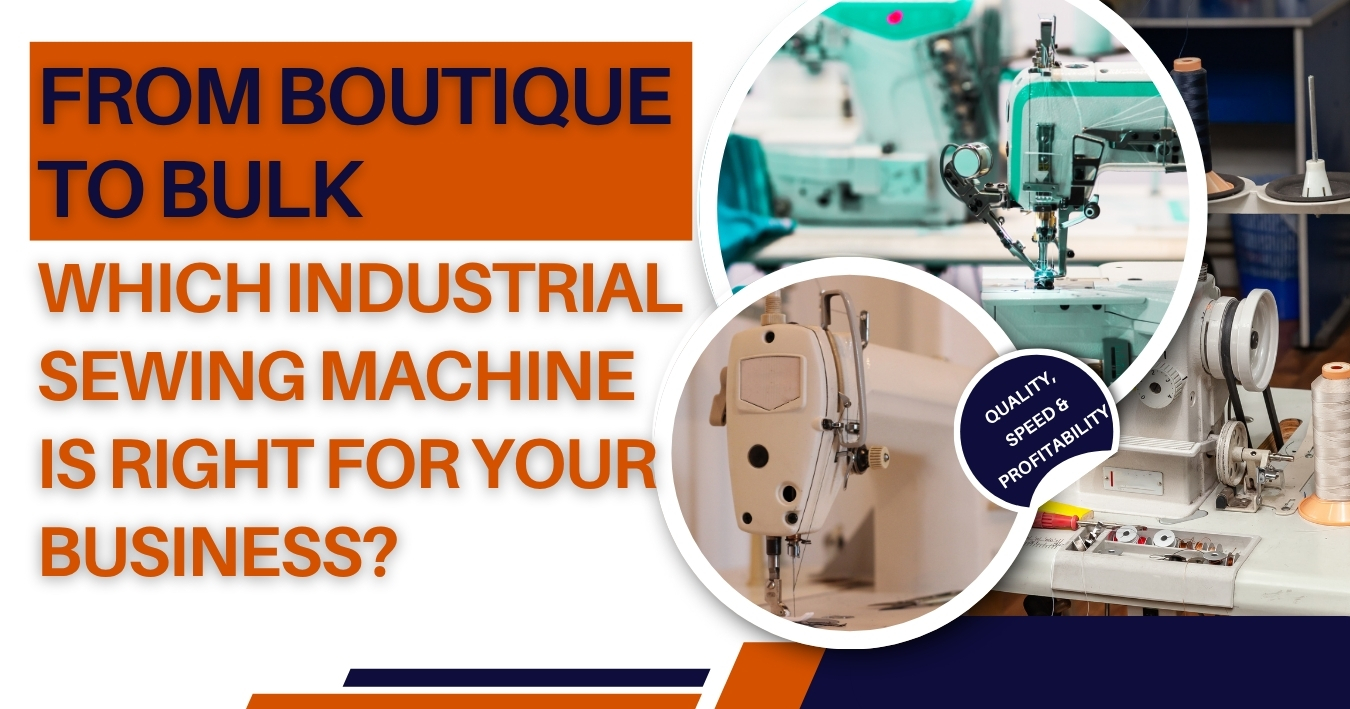
If you’re scaling up your tailoring business-from custom boutique orders to bulk production-you’ll need a sewing machine that can keep up. Choosing the right industrial sewing machine directly affects quality, speed, and profitability. This guide will help you decide between entry-level direct-drive models perfect for boutique work and heavy-duty industrial systems ideal for high-volume production.
Domestic vs Industrial Sewing Machine: Know the Difference
Domestic machines are designed for home use with light fabrics and occasional sewing. Though versatile, they often lack the speed, power, and durability needed for commercial output.
Industrial machines, on the other hand, are built for continuous operation. They feature stronger motors, robust components, and higher stitch rates-upgrading to one signifies a serious scaling decision.
Direct‑Drive Industrial Machines: Boutique-Ready and Efficient
Jack A2C / F4 / H6: Direct-Drive Workhorses
- Advantages: In-built servo motor, automatic thread trimming, energy-efficient and compact design
- Ideal For: Tailoring units producing hundreds of pieces per month; compact yet powerful for boutique studios
- Best Features: Low noise, adjustable speed control, minimal vibration—perfect for smaller spaces
Singer 9900: Heavy-Duty Lockstitch Performer
- Advantages: 5,500 stitches per minute, direct-drive motor, knee lift and automated trim
- Ideal For: Medium-sized garment orders, complex patterns, frequent stitching
- Best Features: High stitch variety, consistent performance, easy maintenance
Clutch Motor Industrial Machines: The Cost-Effective Bulk Solution
Jack 2060: Top & Bottom Feed for Heavy Fabrics
- Advantages: Durable clutch motor, perfect for denim, canvas, or upholstery
- Ideal For: Factories, upholstery workshops, and uniform production
- Best Features: Heavy-duty feeding, high torque, reliable for multi-layer jobs
Singer Topaz 50: High-Performance for Garment Factories
- Advantages: Powerful clutch motor with high-speed consistent stitching
- Ideal For: Factories producing mass clothing lines
- Best Features: High RPM, long operational duty, minimal maintenance costs
Feature Comparison: Boutique vs Bulk
| Feature | Direct‑Drive Industrial (Boutique) | Clutch Motor Industrial (Bulk) |
|---|---|---|
| Power Source | Servo motor integrated into sewing head | Belt-driven external clutch motor |
| Noise & Vibration | Low noise, minimal shaking | Noticeable noise, heavy vibration |
| Speed & Efficiency | Moderate-to-high, adjustable speeds | High speed, full-throttle operation |
| Energy Usage | Energy-efficient (runs as needed) | Constant high power draw |
| Machine Footprint | Compact and built into desk | Requires space for motor and belt setup |
| Maintenance Needs | Low-maintenance; less frequent service | Requires belt checks and potential replacement |
| Fabric Handling | Great for light to medium weights | Excellent for thick, layered materials |
| Cost | Higher upfront; efficient long-term use | Lower initial cost; higher running expense |
When to Choose Boutique‑Grade Direct‑Drive Machines
- Your business focuses on custom work, ethnicwear, fashion pieces
- You need machines that run quietly in compact studios
- You require adjustable speeds for fine detailing
- You prefer machines with minimal maintenance
- You pattern sew in smaller batches with limited space
When to Opt for Clutch Motor Industrial Machines
- You produce uniforms, denim, upholstery, or garments in large volumes
- Noise and vibration aren’t concerns in a factory environment
- You can accommodate external motor units with belt systems
- Your production process is continuous and high-speed
- You prefer a lower initial investment
Real-World Scenarios
Boutique Studio: Jack F4C / Singer 9900
A designer making custom dresses uses a Jack F4C due to its compact size and quiet operation. It offers consistent stitch quality and adjustable speed-ideal for elegant detailing.
Small Workshop: Jack A2C
Producing a few dozen outfits weekly, this owner values energy efficiency and a smaller footprint. The powerhouse motor and auto-thread trim boost productivity.
Mass Production Factory: Jack 2060
An upholstery unit produces thousands of cushion covers monthly. A powerful clutch motor and synchronized feed system keeps operations smooth despite bulk requirements.
Garment Unit: Singer Topaz 50
A factory stitching school uniforms benefits from its steady speed, continuous operation, and cost-effective maintenance.
Investing in the Right Machine
- Evaluate your production volume: Boutique output calls for direct-drive; factories need clutch motors for speed
- Assess workspace and budget: Smaller spaces benefit from direct-drive; larger facilities can house clutch setups
- Identify your cloth types: Use direct-drive for lightweight fabrics and clutch motors for heavy-duty materials
- Consider energy and maintenance impacts: Direct-drive saves on long-term power and upkeep, while clutch motors need regular servicing
Frequently Asked Questions (FAQs)
Can one machine do both boutique and bulk work?
Yes, but industrial machines may be oversized for boutique needs, and boutique models too small for bulk tasks.
Are clutch motors louder than direct-drive?
Yes. They tend to be noisier due to external motor and mechanical parts—better suited for noisy factory spaces.
Is a direct-drive machine more energy-efficient?
Definitely. It runs only when sewing, consuming significantly less power than clutch motors that run continuously.
Do clutch motors require more maintenance?
Yes. Their belts and pulleys need regular tension checks and changes, which can interrupt production.
What’s the ideal investment if I’m growing?
Start with a direct-drive for boutique work and add clutch motor machines only when bulk orders justify the switch.
Final Take
From boutique elegance to bulk production, choosing the right sewing machine is critical. If you work in small batches and need precision with low noise, direct-drive industrial machines are the way to go. But if you want high-speed output and a budget-friendly solution to large-scale production, clutch motor machines remain reliable.
Assess your workflow needs, fabric usage, space, and long-term goals before deciding. At Murthy Sewing Machines, we offer personalized guidance, free delivery, and a 1-year service guarantee on both direct-drive and clutch motor industrial machines. Choose wisely to grow your tailoring business with confidence and control.