


Best Industrial Sewing Machine for Bag Making, Leather & Upholstery Work

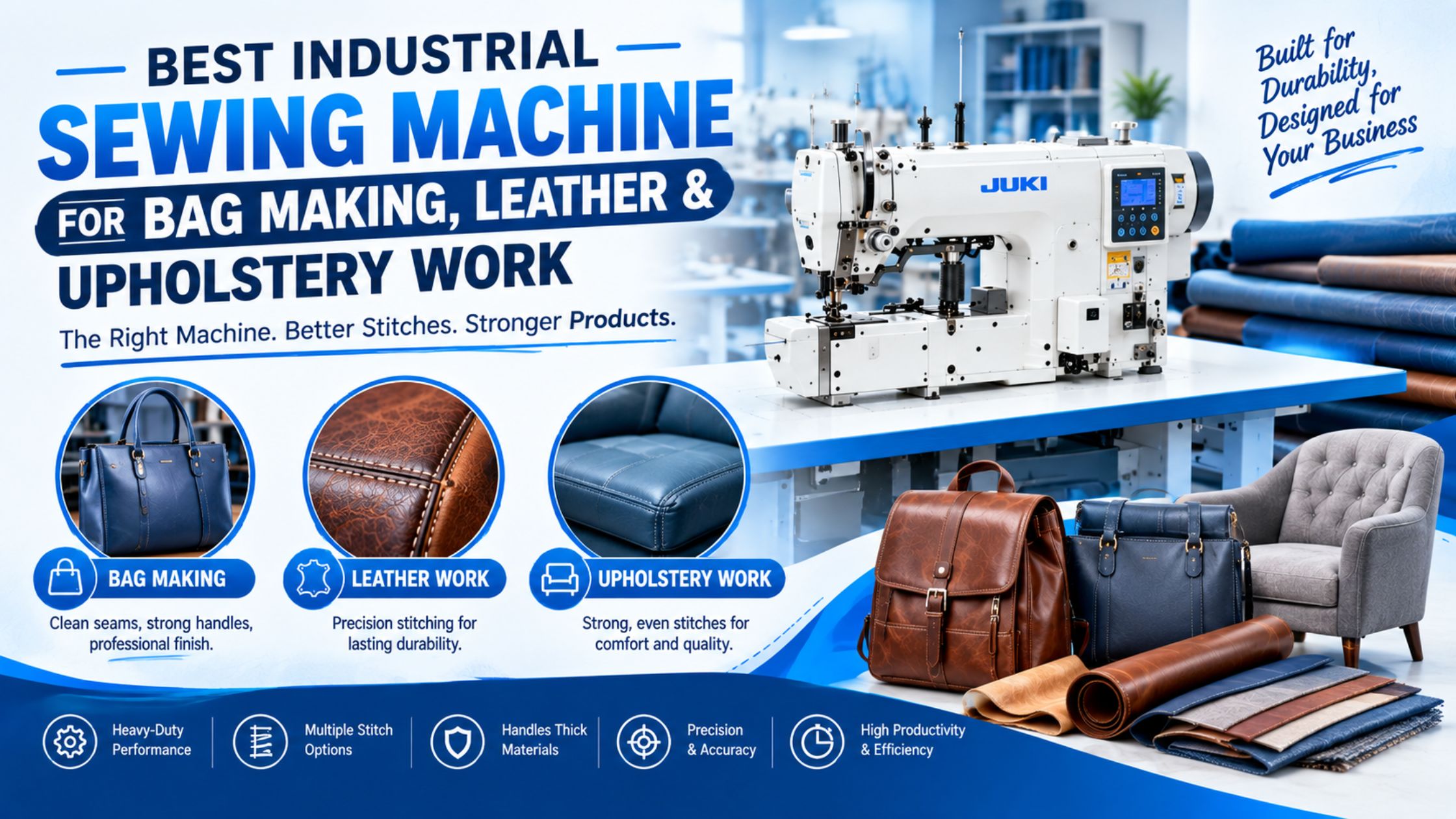
For many bag-making, leather and upholstery applications, a walking-foot or compound/unison-feed industrial lockstitch machine is more appropriate than a standard garment lockstitch because it provides better control when feeding thick, layered or difficult materials.
However, there is no single “heavy-duty machine” for every job. Flat-bed, cylinder-bed, post-bed, needle-feed and compound-feed machines each solve different material-handling problems.
Choose by material + thickness + product shape + seam operation, not by the label “heavy duty.”
Why Normal Garment Machines Can Struggle
Imagine sewing two layers of lightweight shirt fabric.
Now compare that with:
- Multiple layers of leather
- Foam-backed upholstery
- Bag straps
- Piping
- Webbing
- Coated material
- Thick seams
- Curved leather components
The feeding requirement changes significantly.
A normal drop-feed machine moves material primarily using feed dogs beneath the fabric.
With thick or difficult layered assemblies, the top and bottom layers may shift relative to one another.
That can create:
- Uneven seam lengths
- Layer slippage
- Poor stitch consistency
- Difficulty climbing thick intersections
- Material marking
- Irregular feeding
This is why heavy-material applications often require a more suitable feeding system.
What Is a Walking-Foot Sewing Machine?
A walking-foot machine uses presser-foot movement to help feed the material rather than relying only on the lower feed dog.
This can improve control over:
- Layered fabric
- Upholstery
- Vinyl
- Canvas
- Selected leather work
- Bags
- Cushions
- Furniture components
The term “walking foot,” however, is sometimes used broadly.
Always verify the exact feed mechanism of the machine being considered.
What Is Compound Feed / Unison Feed?
A compound-feed or unison-feed system coordinates multiple feeding actions.
Depending on machine design, this may involve the needle, walking presser foot and lower feed working together to move the material.
The objective is improved control of multiple layers.
This type of machine is widely relevant to products such as:
- Leather bags
- Luggage
- Furniture upholstery
- Automotive upholstery
- Canvas products
- Heavy accessories
- Wallets
- Structured goods
It should not be interpreted as meaning the machine can sew every possible leather thickness.
Machine capacity still varies significantly by exact model.
Drop Feed vs Needle Feed vs Walking / Compound Feed
Feed Type | General Strength |
Drop Feed | General sewing and many apparel operations |
Needle Feed | Helps control layer movement in selected applications |
Walking Foot | Improved feeding of layered/difficult materials |
Compound / Unison Feed | Strong synchronized control for many heavy layered applications |
Instead of asking which feed system is “strongest,” ask which one controls your particular material and seam most effectively.
Flat-Bed Machine — Best for Large Flat Components
A flat-bed machine provides a large, stable working surface.
It is useful for operations involving relatively flat components such as:
- Upholstery panels
- Large bag panels
- Covers
- Cushions
- Canvas products
- Flat leather pieces
When most of your stitching happens before the product becomes three-dimensional, flat-bed equipment can be highly practical.
Cylinder-Bed Machine — Better Access Around Curves and Tubular Products
A cylinder-bed machine has a narrow cylindrical working area beneath the needle.
This gives the operator better access around:
- Bag corners
- Tubular pieces
- Small leather goods
- Rounded components
- Certain wallets
- Curved seams
- Finished three-dimensional products
This does not automatically make a cylinder-bed better than a flat-bed machine.
It solves a different handling problem.
A bag manufacturer may use both.
Post-Bed Machines
A post-bed machine positions the sewing area on a raised post.
This configuration can improve access when handling shaped three-dimensional components.
It can be useful for selected:
- Leather goods
- Footwear
- Bags
- Decorative topstitching
- Difficult shaped components
Again, the product geometry determines whether the machine is useful.
Best Machine for Bag Making
“Bag” is too broad a category to recommend one machine.
Consider the difference between:
- Cotton tote bag
- Canvas backpack
- Leather handbag
- Laptop bag
- Travel luggage
- School bag
A lightweight cotton tote may not need the same machinery as a multi-layer leather handbag.
For structured or layered bags, a walking-foot or compound-feed machine may become important.
For difficult curves or already-assembled bag bodies, cylinder-bed equipment can improve access.
Best Machine for Leather
Leather selection requires extra care because different leather goods vary dramatically.
A machine suitable for thin leather accessories may not suit heavy belts or thick saddlery-style work.
Before selecting equipment, consider:
- Leather thickness
- Number of layers
- Thread size
- Required stitch length
- Seam appearance
- Product shape
- Corner radius
- Maximum seam build-up
Never purchase based on a demonstration using a completely different leather from your actual product.
Best Machine for Upholstery
Upholstery frequently involves:
- Thick textile
- Vinyl
- Foam-backed materials
- Piping
- Multiple layers
- Long seams
- Large components
A suitable walking-foot or compound-feed flat-bed machine is therefore commonly considered for upholstery work.
For furniture or automotive applications, the exact feeding requirement and material stack should be demonstrated before purchasing.
Why Motor Power Alone Is Not the Answer
One of the biggest misconceptions in heavy-duty sewing is:
“I need a stronger motor, so the machine will sew thick leather.”
Motor capability matters, but it does not change an unsuitable sewing-machine mechanism into the correct one.
Heavy-material performance can depend on:
- Feed mechanism
- Presser-foot lift
- Hook system
- Needle system
- Thread capability
- Machine construction
- Stitch-length range
- Material thickness
- Operator control
Do not choose a machine by motor wattage alone.
Servo Motor and Speed Control
For detailed bag or leather operations, good low-speed control can be valuable.
Operators often need to sew:
- Corners
- Curves
- Decorative topstitching
- Thick transitions
- Short precision seams
A suitable servo or direct-drive system can offer controllability, depending on the machine configuration.
Again, the entire machine should be evaluated—not simply the motor.

Common Buying Mistakes
Buying a Machine Described Only as “Heavy Duty”
That phrase does not tell you the feed system, material capacity or suitable operation.
Testing One Layer Only
Bring the maximum real production stack you expect to sew.
Ignoring Product Shape
A flat-bed machine may sew the material perfectly while making certain assembled bag areas difficult to access.
Assuming Bigger Needle = Better Machine
Needle selection must match the machine, material and thread.
Choosing on Maximum Speed
Leather and upholstery often require control and consistent feeding rather than simply maximum speed.
Buyer Decision Table
Application | Machine Type to Evaluate |
Light fabric tote bags | Industrial lockstitch / suitable feed |
Layered canvas bags | Walking-foot / compound-feed |
Leather handbags | Compound-feed; cylinder-bed may help |
Wallets and curved leather pieces | Cylinder-bed depending on operation |
Furniture upholstery | Walking-foot / compound-feed flat-bed |
Automotive upholstery | Appropriate compound-feed configuration |
3D leather components | Cylinder-bed or post-bed depending on shape |
These are starting points, not substitutes for testing the exact product.
How to Test Before Buying
Take your real production materials to the dealer.
Prepare:
- Thinnest material stack
- Thickest material stack
- Actual thread
- Sample corners
- Piping if used
- Strap material
- Finished sample or reference product
Test:
- Straight seam
- Slow-speed control
- Curves
- Thick seam intersections
- Reverse stitching where required
- Layer feeding
- Stitch appearance
A real sample is far more useful than asking whether the machine “can sew leather.”
Choosing Heavy-Material Machines with Murthy Sewing Machines
When contacting Murthy Sewing Machines, explain:
- Product being manufactured
- Exact material
- Maximum number of layers
- Thread requirement
- Straight or curved seams
- Flat or three-dimensional components
- Daily production target
- Existing machinery
- Approximate budget
This allows the machine class to be shortlisted around the application rather than a generic heavy-duty label.
Exact specifications, material capability, accessories, price, availability, warranty and service terms should be confirmed for the exact model before purchase.
Conclusion
For bag making, leather and upholstery, the machine’s feeding system and bed configuration can matter as much as basic sewing power.
A useful starting framework is:
General flat work → Flat-bed
Difficult layered material → Walking / Compound Feed
Curved or tubular access → Cylinder-bed
Shaped 3D work → Consider Post-bed
The best industrial sewing machine is therefore not the machine with the biggest motor or the strongest marketing claim.
It is the machine that feeds your actual material reliably and gives the operator proper access to the seam.
FAQs
What sewing machine is best for leather bags?
Many leather bag operations benefit from walking-foot or compound-feed industrial equipment, while cylinder-bed machinery can help with difficult curves and assembled components.
Can an ordinary industrial lockstitch sew leather?
Some machines can sew selected light leather applications, but that does not make a standard drop-feed garment machine ideal for all leather work.
What is the advantage of a walking-foot machine?
It helps control layered or difficult materials by assisting feed from above rather than relying entirely on lower feed dogs.
Is compound feed better than walking foot?
It depends on the exact machine and application. Compound/unison systems provide coordinated feeding that is particularly useful for many layered heavy-material operations.
Why use a cylinder-bed machine for bags?
The narrow bed provides better access around curves, tubular areas and three-dimensional components.
Which machine is best for upholstery?
A suitable walking-foot or compound-feed flat-bed machine is commonly considered, but the actual upholstery material stack should be tested.
Does a bigger motor mean I can sew thicker leather?
Not necessarily. Feed system, machine construction, needle/thread capability and other mechanical factors also determine suitability.
Should I bring material when buying an industrial machine?
Yes. Bring the actual material and maximum seam thickness you expect to sew and request a practical sewing trial.