


School Uniform Stitching Business: Machines, Setup Cost & Season Planning for Tamil Nadu Tailors

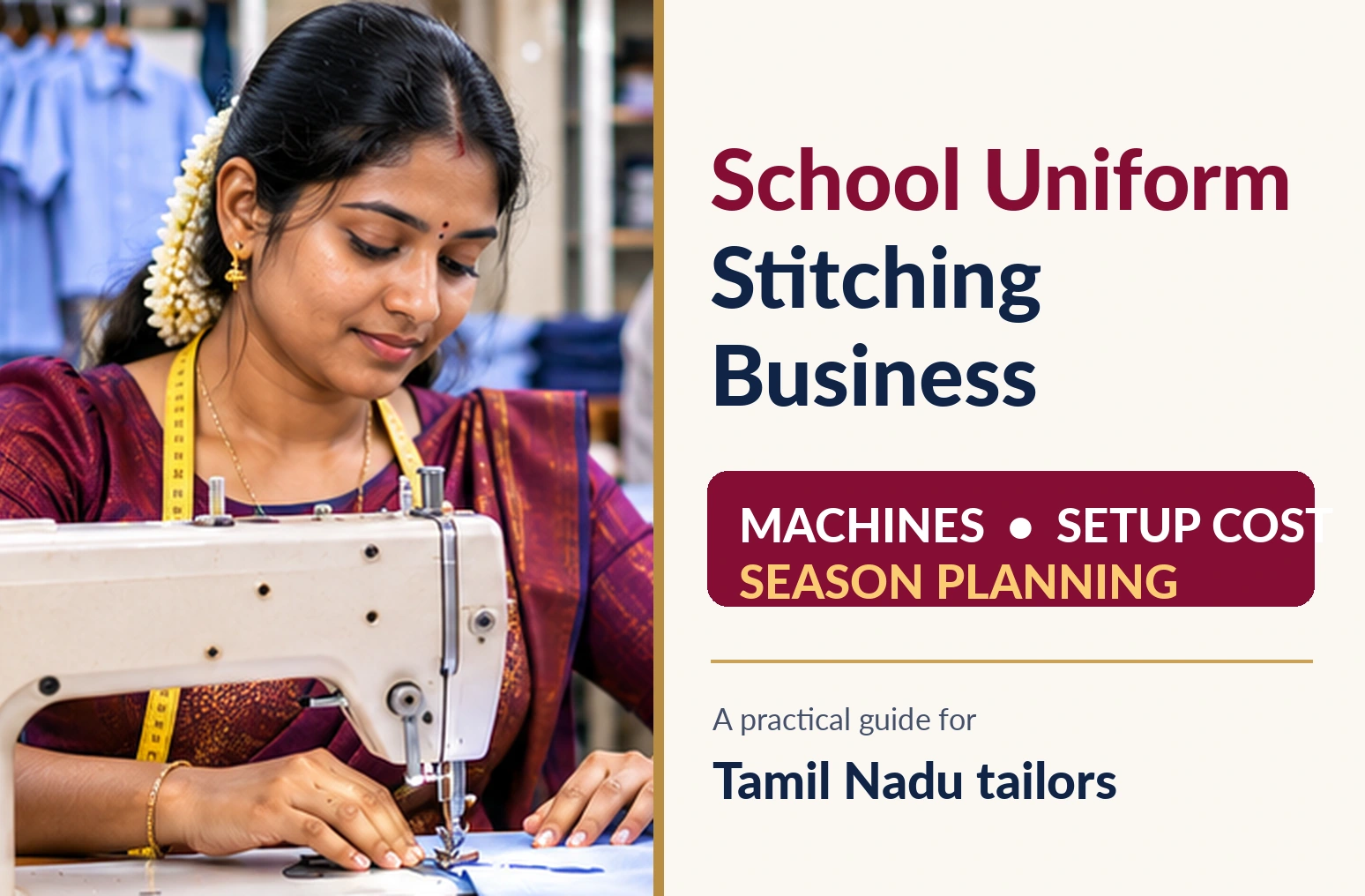
Starting a school uniform stitching business requires a suitable straight-stitch machine, an overlock machine for selected seam-finishing operations, cutting tools and pressing equipment. A home-based tailor can begin with small stitching orders, while bulk uniform manufacturing needs additional machines and workers. Setup costs depend on production capacity, fabric sourcing and whether the business supplies complete uniforms or only stitching services. Planning orders several months before school reopening helps control production delays and expenses.
How to Start a School Uniform Stitching Business in Tamil Nadu
School uniform stitching offers opportunities for tailors who can produce consistent garments in multiple sizes. Schools, uniform retailers and parents need shirts, trousers, skirts, pinafores, salwars and other garments that follow specific patterns.
However, stitching one uniform for an individual customer is different from producing 300 identical shirts for a school.
Bulk orders require accurate cutting, consistent measurements, coordinated machine operations and reliable completion schedules.
Before purchasing equipment, decide which type of uniform business you want to operate.
Three Ways to Start a School Uniform Business
Business Model | How It Works | Suitable For |
Job-work stitching | A customer supplies cut fabric or materials, and you charge for stitching | Tailors with limited capital |
Small uniform tailoring centre | You take measurements, cut and stitch uniforms for parents or local shops | Home tailors and small workshops |
Bulk uniform manufacturing | You source materials and manufacture approved designs in quantities | Established garment units |
Job-work stitching generally requires less material investment because the client supplies some or all of the fabric.
Bulk manufacturing can require substantially more working capital, especially when schools or retailers pay after delivery.
A new business should choose its operating model before estimating profitability.
Which Machines Are Required for School Uniform Stitching?
Machine selection should follow the garment operations.
A woven school shirt, for example, involves different processes from a knitted sports T-shirt.
Machine | Main Operation | Buying Priority |
Single-needle lockstitch | General seams, collars, cuffs, plackets and selected trouser operations | Essential |
Overlock machine | Suitable seam construction and edge finishing | Highly relevant |
Buttonhole machine | Repeated buttonhole production | Add when volume justifies it |
Button sewing machine | Repeated button attachment | Optional initially |
Bartack machine | Reinforcing stress points such as selected pocket openings | Volume-dependent |
Interlock/coverstitch | Hemming selected knitted sportswear | Only if the product requires it |
Embroidery machine | School logos, names and monograms | Optional or outsourced initially |
A home-based tailor does not need every specialised machine on the first day.
The most practical approach is to match each machine to an operation that regularly appears in confirmed orders.
Industrial Lockstitch Machines for School Uniforms
A single-needle industrial lockstitch machine is commonly used for general woven garment construction.
Typical school uniform applications include joining panels, attaching collars, stitching plackets and completing many straight-seam operations.
For businesses producing repeated orders, stitch consistency, fabric feeding, operator comfort and reliable speed control may matter more than the highest advertised sewing speed.
Tailors exploring Juki sewing machines for repeated garment-stitching work should compare the exact model and configuration with their uniform production requirements.
Not every uniform requires an identical lockstitch setup. Fabric thickness, construction and daily workload can change the recommendation.
Overlock Machines for Uniform Finishing
Overlock machines are commonly used for suitable seam construction and finishing raw fabric edges.
For woven uniforms, overlocking selected seam allowances can help reduce fraying and improve the internal garment finish.
Knitted uniforms may require particular overlock configurations for seam assembly.
A suitable industrial overlock sewing machine for uniform edge finishing should be chosen according to the fabric, seam type and number of threads required.
An overlock machine does not replace all straight-stitch operations.
Buttonhole, Button Sewing and Bartack Machines
School shirts commonly require buttons and buttonholes, while some trousers, skirts and other garments require specialised reinforcement.
Small tailoring centres may complete limited buttonhole work using a suitable multipurpose machine or outsource it.
However, repeated bulk orders can make a dedicated buttonhole machine worthwhile.
Businesses planning higher-volume shirt production can compare buttonhole sewing machines for repeated uniform production and examine whether the expected order volume justifies the investment.
Buttonhole machines, button sewing machines and bartack machines perform different operations. They should not be confused with one another.
Do School Uniform Manufacturers Need Embroidery Machines?
Some schools require embroidered logos on shirts, pockets, sportswear or other garments.
For small orders, outsourcing embroidery can reduce the initial investment.
If the business receives regular logo orders, an embroidery machine may become commercially useful.
The decision depends on the number of garments per design, colour changes, stitching complexity and how consistently the machine will be used.
For businesses planning to produce badges and logos in-house, embroidery machines for school uniforms and logo customisation can be considered after evaluating the actual requirement.
School Uniform Stitching Business Setup Cost in Tamil Nadu
The investment required depends on whether you already own sewing equipment, how many people will work in the unit and whether fabric is supplied by the customer.
A basic tailoring business can operate at a much smaller scale than a uniform manufacturing workshop.
Approximate Machine and Equipment Budget
The following ranges are indicative 2026 planning figures informed by published Indian supplier and business guides. They are not confirmed Murthy Sewing Machines quotations.
Equipment | Illustrative Budget |
Industrial single-needle lockstitch | ₹15,000–₹35,000 |
Industrial overlock | ₹20,000–₹45,000 |
Cutting and measuring tools | ₹3,000–₹8,000 |
Cutting table or work surface | ₹5,000–₹15,000 |
Iron and pressing arrangement | ₹5,000–₹18,000 |
Patterns, samples and initial trims | ₹5,000–₹15,000 |
The machine price may or may not include the table, stand, motor or other components. Confirm the exact package before purchasing.
Special-purpose buttonhole, button sewing and embroidery equipment can increase the cost considerably.
Three Practical Investment Levels
Home-Based Job-Work Unit
A tailor who already owns a suitable machine and receives cut fabric from a contractor may only need additional tools, repairs, supplies and working capital.
This is generally the lowest-investment route, but it depends on having access to reliable job-work orders.
Small Two-Machine Workshop
A new workshop with one industrial lockstitch machine, one overlock machine, basic cutting equipment, pressing tools and initial supplies might plan around ₹55,000–₹1.4 lakh for equipment and preparation.
This is an illustrative combined budget, not a fixed market package price. Fabric purchases, rented premises and operating reserves are additional.
Bulk Uniform Manufacturing Unit
A workshop with several operators, cutting equipment, specialised machines and material stock can require several lakhs of rupees.
A published October 2026 business model estimates approximately ₹11 lakh for a multi-machine setup, including considerable working capital.
However, that amount should not be presented as the minimum cost for every school uniform business.
How to Calculate the Cost of One School Uniform
A uniform costing sheet should separate fabric, accessories, labour and operating expenses.
Consider this illustrative costing example for a school shirt and trouser set:
Expense | Example Cost |
Fabric | ₹220 |
Buttons, thread, zip and labels | ₹30 |
Cutting and stitching labour | ₹120 |
Pressing and packing | ₹20 |
Allocated overhead | ₹35 |
Total estimated cost | ₹425 |
If the set sells for ₹500, the difference is ₹75 before any additional unallocated expenses, financing costs or taxes.
The example is purely illustrative. Actual fabric consumption differs significantly between a primary-school child and an older student.
The costing method matters more than copying somebody else's selling price.
How to Avoid Fabric Wastage
In uniform manufacturing, cutting mistakes can affect the entire order.
Before cutting, confirm approved patterns, size charts, seam allowances, fabric direction and shrinkage behaviour.
For striped or checked uniform fabrics, matching the pattern may increase fabric consumption.
Prepare a cutting plan that groups compatible sizes and uses the available fabric width efficiently.
Record actual fabric consumption for each size so future quotations are more accurate.
School Uniform Production and Season Planning
School reopening creates a common deadline for uniform orders, particularly when parents and retailers want garments ready before classes begin.
Tamil Nadu's 2026–27 school reopening was scheduled for early June, with a subsequently revised opening date of June 4, 2026.
However, future reopening dates can change. Businesses should confirm each academic year's official calendar rather than assuming the same date every year.
A Practical Uniform Production Calendar
Period | Suggested Business Activity |
December–January | Contact schools and uniform retailers, review previous orders |
February | Confirm samples, fabrics, measurements and quotations |
March | Finalise purchase orders, materials and production schedules |
April | Begin approved cutting and bulk stitching |
May | Complete priority orders, quality checks, packing and dispatch |
June | Handle confirmed late orders, alterations and size exchanges |
July–November | Serve new admissions, replacements and other garment customers |
This is a recommended business-planning calendar, not an official government production schedule.
Some schools procure uniforms earlier or use different suppliers and ordering cycles.
Do not purchase large fabric quantities solely on the expectation that seasonal orders will arrive.
How to Estimate Daily Stitching Capacity
Theoretical sewing-machine speed does not equal completed garment output.
A practical capacity estimate is:
Daily output = Available productive operator minutes ÷ Standard minutes per garment
For example, suppose an operator has 360 productive minutes available daily and a particular garment requires 45 minutes of that operator's work.
Theoretical output would be eight garments per day.
Actual output may be lower because of size changes, rework, pressing, material movement and interruptions.
For a multi-operator production line, calculate the capacity of each operation separately.
If cutting prepares 100 shirts daily but buttonhole finishing can process only 40, the buttonhole operation may become the bottleneck.
Should You Buy More Machines Before School Reopening?
Not necessarily.
Before purchasing another machine, check whether the existing equipment is fully utilised and whether orders have been confirmed.
An additional operator or better material preparation may sometimes improve output without buying another machine.
Conversely, if the unit consistently has a queue of garments waiting for overlocking or buttonhole work, operation-specific equipment may be justified.
Investment decisions should follow measured bottlenecks rather than estimated maximum machine RPM.
Quality Control Checklist Before Delivery
School uniforms must be consistent across sizes and repeated orders.
Check the following before packing:
- Approved fabric colour and design.
- Correct garment size and measurement tolerance.
- Collar, sleeve and pocket alignment.
- Stitch consistency and seam security.
- Button and buttonhole position.
- Suitable reinforcement at stress points.
- No loose threads, stains or visible defects.
- Correct school logo, label and packing.
- Quantity matching the approved order.
A sample garment approved by the customer should remain available throughout the production run.
How to Get School Uniform Orders and Build a Sustainable Business
Approach Schools with Samples, Not Just Prices
Prepare a sample shirt, trouser, skirt or other required garment using the school's specifications.
Explain your stitching capacity, fabric sourcing arrangements, available sizes, correction policy and delivery process.
A written quotation should clearly state whether the price includes fabric, stitching, logos, labels, pressing, packing and transport.
For large orders, agree on payment milestones and delivery schedules before purchasing materials.
Work with Uniform Shops and Garment Contractors
Local uniform retailers may need stitching partners during busy periods.
This can be an accessible starting point for tailors who do not yet have direct school contracts.
Job-work arrangements may reduce the responsibility for sourcing fabric, but prices and payment terms must be checked carefully.
Do not accept a large order without understanding the required operations and available production capacity.
What About Government and Institutional Uniform Orders?
Government-related procurement and larger institutional orders may involve prescribed tender, qualification, quality and documentation requirements.
A small workshop should not assume it can obtain such contracts without meeting the relevant conditions.
For business formalisation, eligible enterprises can use the official Udyam Registration portal. Government Udyam registration is free.
GST, local licensing and other legal requirements depend on the business structure and activity. Confirm those obligations with a qualified professional or the appropriate authority.
How to Manage Business Outside the School Season
Relying entirely on school reopening orders can create uneven workloads.
A uniform workshop may also explore office uniforms, hospital garments, hotel uniforms, alterations and other suitable stitching services.
These products may require different fabrics, patterns or machines.
Diversify only where the business has the technical ability and confirmed customer demand.
Where to Buy Sewing Machines for Uniform Stitching in Chennai
Before buying equipment, prepare a list of the uniforms you intend to stitch.
Identify whether the work involves woven shirts, trousers, skirts, pinafores or knitted sportswear, along with the expected daily production and number of operators.
Customers looking for sewing machine dealers in Chennai for school uniform manufacturing setups can contact Murthy Sewing Machines to discuss suitable equipment for different garment operations.
Final machine selection should consider stitch type, fabric, production workload, configuration and available budget.
Conclusion
Starting a school uniform stitching business in Tamil Nadu requires more than buying a sewing machine and accepting bulk orders.
The business must match each garment operation to suitable equipment, calculate realistic material and labour costs, and schedule production according to confirmed delivery requirements.
New tailors can begin with a limited setup and outsource specialised operations until consistent demand justifies additional investment.
For larger orders, approved samples, accurate size charts, careful fabric cutting and quality control become essential.
Before buying machines, identify the uniforms being produced, daily target output, existing equipment and budget. That information will help Murthy Sewing Machines recommend a setup suited to the actual workload rather than an unnecessarily expensive configuration.
FAQs
1. Which sewing machine is best for school uniform stitching?
An industrial single-needle lockstitch machine is commonly useful for woven school shirts, trousers and skirts. An overlock machine may be needed for suitable seam finishing. The correct machine combination depends on the garment design and production volume.
2. How much does it cost to start a school uniform stitching business?
Costs depend on the scale. A small two-machine workshop may plan around ₹55,000–₹1.4 lakh for selected equipment and initial preparation, excluding major fabric stock, rent and other operating reserves. Larger manufacturing units require substantially more investment.
3. Can I start school uniform stitching from home?
Yes. A home tailor can begin with measurements, alterations, small orders or job-work stitching if the existing equipment is suitable. Bulk orders require more careful planning around capacity, fabric storage, cutting and delivery commitments.
4. Is an overlock machine necessary for school uniforms?
Many uniform designs benefit from suitable overlock seam or edge finishing, but the requirement depends on fabric and construction. A straight-stitch machine and an overlock machine perform different operations, so one should not automatically replace the other.
5. Do I need an embroidery machine for school logos?
Not necessarily. Small businesses can outsource school logos and embroidery initially. Purchasing an embroidery machine becomes more relevant when repeated order volume and production requirements justify bringing that work in-house.
6. When should school uniform production begin in Tamil Nadu?
Preparation should begin several months before the expected reopening period. Samples, specifications, purchase orders and materials should be confirmed before bulk cutting. Production timing depends on the school's approved delivery date and the workshop's actual capacity.
7. Is school uniform stitching a profitable business?
It can be profitable when orders are priced correctly, materials are managed carefully and machines and workers remain productively utilised. Actual results depend on fabric costs, labour, rejection rates, payment delays and overhead expenses. No fixed income can be guaranteed.
8. How many sewing machines are needed for 500 school uniforms?
There is no universal machine count. The number depends on the garment design, time required for each operation, available operators, working shifts and the delivery deadline. A production plan should identify the capacity of each operation before determining machine quantity.