


Sewing Thread Guide: Cotton vs Polyester vs Core-Spun, Tex Sizes & Matching Thread to Needle and Fabric

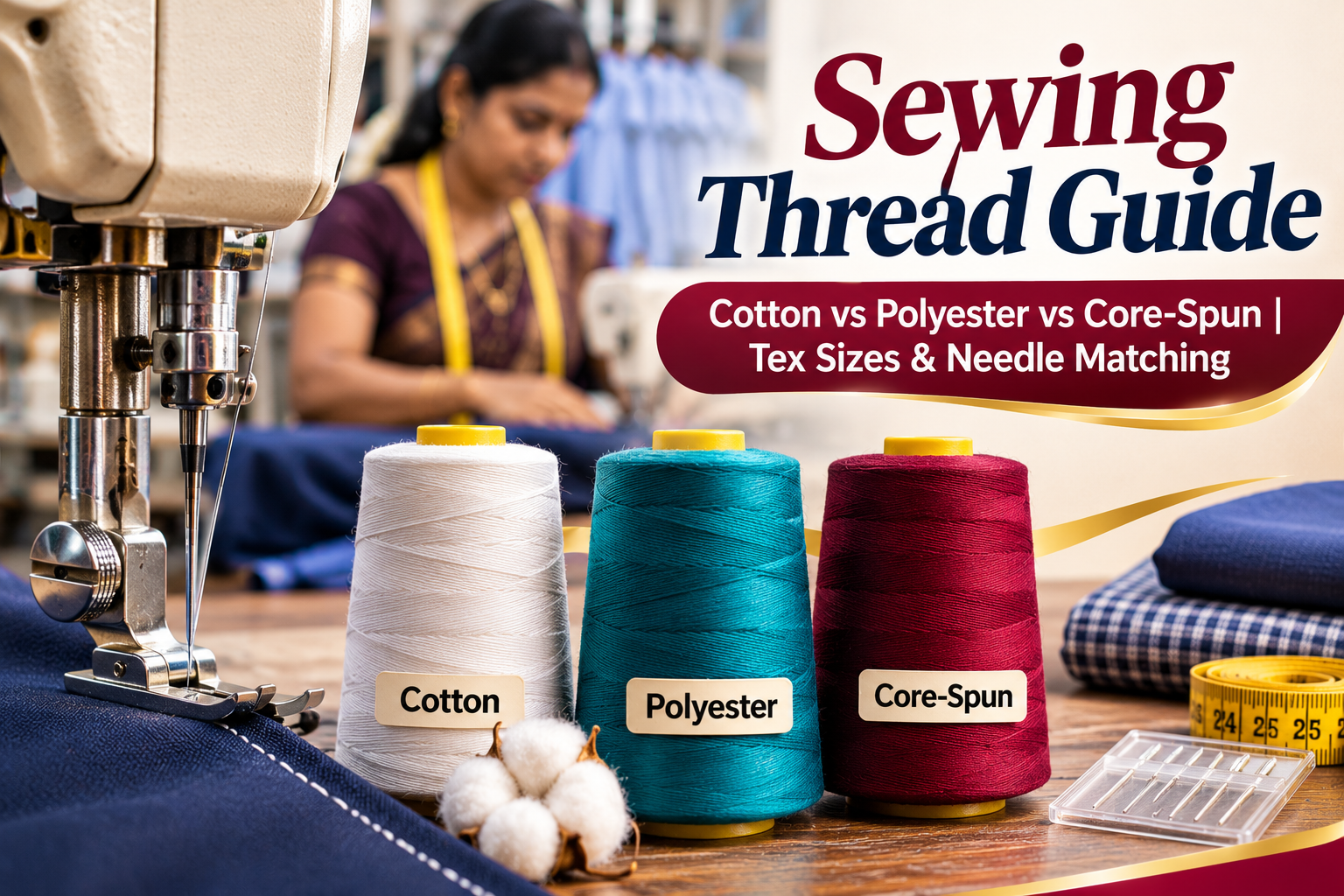
Cotton thread suits selected natural-fibre and traditional sewing applications, while polyester is a versatile choice for everyday garments and many commercial sewing operations. Core-spun thread combines a strong filament core with an outer fibre covering and is commonly used in garment manufacturing. Thread thickness is measured using systems such as Tex, where a higher number means a heavier thread. The correct needle must suit both the thread thickness and the fabric, with final selection confirmed through stitch testing.
Cotton vs Polyester vs Core-Spun Sewing Thread: Which Should You Choose?

Choosing sewing thread is not simply about matching the colour to the fabric. The thread must pass smoothly through the machine, form a balanced stitch and withstand the stresses placed on the finished seam.
A thread that works well for a lightweight cotton blouse may not suit heavy denim, repeated industrial stitching or an elastic knitted garment.
Three important thread categories are cotton, polyester and core-spun.
What Is Cotton Sewing Thread?
Cotton sewing thread is manufactured from natural cotton fibres that are spun and twisted into thread.
It is commonly associated with traditional sewing, cotton garments, quilting and selected applications where the characteristics of natural fibres are preferred.
Mercerised cotton thread has undergone treatment that can improve its appearance and certain performance properties.
Advantages of cotton thread:
- Natural-fibre composition.
- Suitable for selected cotton garments and traditional sewing work.
- Often preferred for particular quilting and decorative applications.
- Available in different constructions and sizes.
Cotton thread also has limitations. Compared with high-quality polyester thread of a similar size, it generally has lower strength and elongation.
For high-speed industrial production or seams that experience repeated stretching, it may not be the most suitable option.
What Is Polyester Sewing Thread?
Polyester is one of the most widely used materials in modern sewing thread manufacturing.
It offers a useful combination of strength, abrasion resistance and versatility across many garment applications.
However, not all polyester threads have the same construction.
Spun polyester thread is produced from short polyester fibres twisted together. It is commonly used for general garment stitching.
Continuous-filament polyester thread uses continuous filaments and is often selected where particular strength, appearance or performance properties are required.
Textured polyester thread has a different structure and is used in selected overlock and coverstitch operations, particularly in looper positions.
The exact product must be selected according to its intended application.
Polyester thread is often suitable for shirts, trousers, uniforms, casual garments and many commercial sewing operations.
It is not automatically the right choice for every delicate fabric or specialised seam.
What Is Core-Spun Sewing Thread?
Core-spun sewing thread is manufactured using a filament core surrounded by staple fibres.
A common construction uses a continuous polyester filament core covered with either polyester or cotton fibres.
This design combines the strength and elongation characteristics of the core with useful surface and sewing characteristics from the outer fibres.
Core-spun thread is commonly used in professional garment manufacturing, especially where consistent stitching and seam strength matter.
Typical applications may include shirts, trousers, workwear, denim and other repeated garment-production operations.
There are different core-spun constructions, including polyester/polyester and polyester/cotton. They should not be treated as identical products.
Cotton vs Polyester vs Core-Spun: Comparison Table
Feature | Cotton | Polyester | Core-Spun |
Construction | Natural spun fibres | Spun or filament synthetic fibres | Filament core with fibre covering |
General strength | Lower than comparable high-tenacity synthetic options | Often good | Often high for its intended use |
Stretch and elongation | Generally lower | Varies by construction | Combines core elongation with outer-fibre characteristics |
Common applications | Traditional sewing, selected cotton garments, quilting | General tailoring and garment production | Repeated commercial garment stitching |
Industrial suitability | Application-dependent | Commonly used | Commonly used |
Best selection factor | Fabric and desired seam properties | Thread construction and workload | Required seam strength and sewing performance |
Which is best?
For everyday stitching, a good-quality polyester thread is often a practical starting point. Cotton may be preferred for particular natural-fibre applications, while core-spun is worth considering for repeated garment production requiring its performance characteristics.
There is no universal winner. The correct choice depends on the seam and garment requirements.
Sewing Thread Tex Sizes Explained
Thread thickness plays an important role in stitch appearance, seam strength, fabric damage and needle compatibility.
A thread that is too heavy may require a larger needle and produce visible holes in fine fabric.
A thread that is too fine may not provide the strength or appearance needed for a demanding seam.
What Does Tex Mean in Sewing Thread?
Tex is a standard measurement of linear density.
It represents the weight, in grams, of 1,000 metres of thread or yarn.
Tex = Thread weight in grams per 1,000 metres
For example:
- Tex 24 means 1,000 metres weighs 24 grams.
- Tex 40 means 1,000 metres weighs 40 grams.
- Tex 60 means 1,000 metres weighs 60 grams.
- Tex 80 means 1,000 metres weighs 80 grams.
Therefore, a higher Tex number indicates a heavier, generally coarser thread.
Tex describes mass per unit length, not the exact diameter, strength or suitability of a thread.
Two threads with the same Tex number can perform differently because of differences in fibre type, construction and finishing.
Sewing Thread Tex Size and Needle Size Chart
The following chart is adapted from Coats' apparel thread conversion guidance.
Thread Size | Typical Metric Needle Range | Singer/US Needle Size |
Tex 18 | Nm 65–75 | 9–11 |
Tex 24 | Nm 70–75 | 10–11 |
Tex 27–30 | Nm 80–100 | 12–16 |
Tex 35 | Nm 80–100 | 12–16 |
Tex 40 | Nm 90–100 | 14–16 |
Tex 45–50 | Nm 90–110 | 14–18 |
Tex 60 | Nm 110–130 | 18–21 |
Tex 80 | Nm 120–140 | 19–22 |
These are manufacturer-published reference ranges, not universal prescriptions.
The appropriate needle depends on thread construction, fabric density, stitch type, machine needle system and operating conditions.
For example, an Nm 100 needle may provide sufficient thread clearance but still be unnecessarily large for a delicate fabric.
Always perform a seam test.
What Is the Difference Between Tex and Ticket Number?
Sewing thread may also be labelled using ticket numbers.
This can confuse buyers because ticket systems do not all follow the same direction or conversion method.
In the metric ticket system commonly used for synthetic sewing thread:
- Higher ticket numbers generally indicate finer thread.
- Lower ticket numbers generally indicate heavier thread.
This is the opposite of Tex, where higher numbers indicate heavier thread.
For the metric ticket system described by Coats, an approximate conversion is:
Metric Ticket Number = 3,000 ÷ Tex
For example, Tex 40 corresponds approximately to Metric Ticket 75.
However, this formula should not be applied blindly to every manufacturer-specific, cotton-count or regional ticket designation.
When buying thread, check the manufacturer's stated Tex size rather than relying only on a package number.
How to Match Sewing Thread to Fabric and Needle Size
A good thread selection starts with the material and the seam's purpose.
Fabric thickness matters, but so do the fabric structure, the number of layers, seam movement and desired stitch appearance.
Sewing Thread for Cotton Shirts and School Uniforms
For many woven cotton shirts, school uniforms and everyday garments, a suitable polyester or core-spun thread is a practical option.
Finer threads may suit lightweight shirts, while slightly heavier thread may be selected for particular seams requiring additional strength.
The needle must form a neat stitch without leaving excessive holes or causing fabric damage.
Before selecting a thread for a production unit, test the approved fabric, seam allowance and number of layers.
Sewing Thread for Silk, Chiffon and Lightweight Fabrics
Delicate fabrics generally require careful selection of fine thread and appropriately sized needles.
A heavy thread can produce visible stitching, puckering or fabric distortion.
The stitch should be strong enough for its purpose without unnecessarily stressing the material.
For expensive silk or fine synthetic fabrics, use a matching sample to test stitch appearance, thread tension and pressing behaviour.
Sewing Thread for T-Shirts, Lycra and Knitwear
Knit fabrics behave differently from woven fabrics because their structure allows movement and stretching.
Choosing a stronger thread alone does not guarantee a stretchable seam.
A suitable seam construction, stitch type, thread and machine configuration must work together.
For example, certain knit garment operations use overlock and interlock/coverstitch machines, with textured polyester threads selected for appropriate looper positions.
Businesses handling regular knitwear production can compare overlock sewing machines for T-shirt seams and knit fabric finishing while checking the thread and needle requirements of the chosen machine.
Do not assume that every stretch fabric requires the same thread thickness.
Sewing Thread for Denim and Heavy Fabrics
Denim often requires stronger thread and careful attention to seam construction.
A heavier core-spun or other suitable industrial thread may be selected for visible topstitching and demanding seams.
However, heavy topstitching thread does not necessarily need to be used for every seam in the garment.
The needle size must accommodate the thread while passing through multiple fabric layers without excessive deflection or material damage.
For businesses working with bags, canvas or thicker textiles, suitable heavy-duty sewing machines for multi-layer fabric applications should be considered according to the material and feeding requirements.
The phrase 'heavy-duty thread' alone is not enough to specify a machine, needle or seam.
Quick Fabric, Thread and Needle Selection Guide
Fabric or Application | Thread to Consider | Needle Selection Principle |
Fine silk or chiffon | Suitable fine polyester or other compatible thread | Fine needle that does not damage the fabric |
Lightweight cotton | Fine-to-medium polyester or cotton | Match thread clearance and fabric structure |
School uniforms | Suitable polyester or core-spun | Test across seams and multiple layers |
T-shirts and knitwear | Suitable polyester; textured thread where applicable | Appropriate knit point and seam construction |
Denim | Stronger polyester or core-spun, as required | Match heavier seams and thread size |
Canvas and bags | Application-specific industrial thread | Select for layers, feeding and seam strength |
Decorative topstitching | Suitable heavier decorative thread | Allow sufficient eye and groove clearance |
These are starting points for testing, not fixed combinations for every machine.
How to Choose the Correct Sewing Machine Needle for Your Thread
Even a good-quality thread can break repeatedly when paired with the wrong needle.
Needle selection should consider three separate factors: needle system, needle size and needle point.
Needle System vs Needle Size
The needle system describes the needle's physical dimensions and compatibility with a particular machine.
Needle size describes its thickness.
Two needles marked with the same size may belong to different systems and may not be interchangeable.
Always follow the needle system specified in the sewing machine manual.
Why Needle Eye Clearance Matters
The thread must pass smoothly through the needle eye and along the groove during stitch formation.
When the thread is too thick for the needle, friction can increase.
This may contribute to thread heating, fraying, breakage or inconsistent stitch formation.
Using an unnecessarily large needle can create another problem: visible holes or fabric damage.
The correct needle is therefore not simply the largest one that can carry the thread.
Needle Point Selection for Woven and Knitted Fabrics
Woven and knitted fabrics can require different needle point shapes.
For many woven fabrics, appropriate regular or rounded points are used according to the material and stitch operation.
For knitted fabrics, suitable ball-point variants can help reduce damage to yarns and loops.
Groz-Beckert recommends choosing the needle based on the material, seam, needle system and required point style.
A needle selected only by its size number may still be wrong for the fabric.
Five Checks Before Starting a Production Run
Before producing a large quantity of garments, complete these checks:
- Confirm that the needle system matches the machine.
- Select a suitable thread material and thickness.
- Choose a needle size that allows smooth thread movement.
- Test the stitch on the actual fabric and number of layers.
- Check for puckering, skipped stitches, thread damage and seam weakness.
A short production test can prevent more expensive rework later.
Common Sewing Thread Problems and How to Fix Them
Why Does Sewing Thread Keep Breaking?
Thread breakage can have several causes.
Possible reasons include incorrect threading, excessive tension, a damaged needle, an unsuitable needle eye, rough thread guides, poor-quality thread or the wrong thread-to-fabric combination.
Start by checking the threading path and needle condition.
Replace a bent, blunt or damaged needle with a compatible one.
Then test tension and thread movement according to the machine manual.
Do not increase needle size automatically without checking whether the fabric can accommodate it.
What Causes Skipped Stitches?
Skipped stitches can result from needle problems, fabric movement, incorrect machine timing or an unsuitable thread and needle combination.
Stretch fabrics may be particularly sensitive to needle point choice and fabric handling.
Check needle installation, compatibility and condition first.
If the problem continues, the machine may require a mechanical inspection.
Why Does Fabric Pucker During Sewing?
Puckering can occur when the fabric is displaced or compressed around the stitches.
Potential contributing factors include thread tension, stitch density, feeding problems and an unsuitable needle or thread size.
Fine fabrics may show these problems more clearly.
Test a finer compatible thread or needle where appropriate, and review the machine setup before changing multiple settings at once.
Can Poor Thread Quality Affect Machine Performance?
Yes. Irregular thread thickness, excessive lint, uneven twisting and unsuitable surface finishes can contribute to inconsistent sewing performance.
A thread that repeatedly frays or produces excessive lint may increase cleaning and troubleshooting requirements.
The correct response is not necessarily to purchase a more expensive sewing machine.
Sometimes the immediate solution is a better-matched thread, a new compatible needle or correction of the threading path.
Tailors looking for compatible needles, bobbins and maintenance items can explore sewing machine spare parts and accessories for stitching maintenance.
How to Buy Sewing Thread and Match It to Your Sewing Machine

Before buying large quantities of thread, record the thread type, Tex size, colour, manufacturer and machine application that performed well during testing.
For commercial sewing, consistency between thread batches can also matter.
Ask the supplier about recommended needle sizes and the thread's intended applications.
When changing from cotton to polyester or from a spun thread to a core-spun construction, do not assume the existing machine tension and needle will always remain suitable.
Choosing Thread for Domestic Sewing Machines
Many domestic machines are designed around general-purpose threads and appropriate household needle systems.
They may not be suitable for very heavy industrial threads.
When selecting home sewing machines for different fabric and stitching requirements, check the supported needle system, fabric capability and recommended thread types.
Choosing Thread for Industrial Garment Production
Industrial sewing businesses should evaluate the thread alongside the sewing operation.
A lockstitch operation on woven fabric differs from an overlock operation on knitwear or a heavy-material seam.
Machine speed, operator workload, seam strength, fabric compatibility and thread consumption all affect the final decision.
Customers searching for sewing machine dealers in Chennai for industrial stitching and thread compatibility guidance can contact Murthy Sewing Machines to discuss their fabric, machine type, needle system and required seam.
Bring the current thread package and a stitched sample when enquiring about a recurring sewing problem.
Conclusion
Selecting sewing thread correctly requires understanding more than colour and spool size.
Cotton, polyester and core-spun threads offer different properties. Tex numbers help describe thread thickness, while needle size and point selection influence how successfully the thread forms a stitch in the chosen fabric.
For home tailoring, begin with the garment material and required stitch. For industrial production, also consider seam strength, machine class, repeated workload and production quality.
Always test the proposed thread and needle combination before beginning important work.
If stitching problems continue after basic checks, provide the thread type, needle specification, fabric sample and machine model when seeking technical guidance. This information makes it easier to identify whether the issue comes from consumables, machine setup or an unsuitable sewing operation.
FAQs
1. Which is better for sewing: cotton or polyester thread?
Polyester is a versatile choice for many everyday garments because of its strength and abrasion resistance. Cotton thread remains suitable for selected traditional, natural-fibre and quilting applications. The better choice depends on the fabric, seam and required performance.
2. What is core-spun sewing thread used for?
Core-spun thread is widely used in commercial garment stitching, including selected shirts, trousers, workwear and denim applications. It combines a continuous-filament core with an outer fibre covering to achieve useful strength and sewing characteristics.
3. What is Tex 40 sewing thread?
Tex 40 means that 1,000 metres of the thread weighs 40 grams. It is a measure of linear density, not a direct measurement of strength or diameter. The suitable application depends on the thread's construction and manufacturer recommendations.
4. Which needle size should I use for Tex 40 thread?
Coats' apparel thread conversion chart lists approximately Nm 90–100, or Singer/US 14–16, for Tex 40. This is a reference range. Final needle selection depends on fabric, thread construction and machine compatibility.
5. Does thicker sewing thread always make a stronger seam?
Not always. Thicker thread may have greater strength when compared with similar fibre and construction, but seam strength also depends on stitch type, stitch density, fabric, needle damage and thread quality. An unnecessarily heavy thread can reduce sewing quality.
6. Can I use industrial sewing thread in a home sewing machine?
Some industrial-type threads may be compatible with certain domestic machines, but heavy thread can exceed the machine's intended needle and tension capabilities. Check the machine manual and test the exact thread before using it regularly.
7. Which sewing thread is suitable for T-shirts and stretch fabrics?
Suitable polyester threads are commonly used for knit garments. Some overlock and coverstitch operations also use textured polyester threads in looper positions. The machine's stitch construction and appropriate needle point are important for achieving the required seam stretch.
8. Why does sewing thread break even with a new needle?
A new needle does not eliminate all possible causes of thread breakage. The needle may be incorrectly sized or installed, and problems can also arise from excessive tension, rough thread guides, unsuitable thread, incorrect threading or machine adjustments.