


Best Sewing Machine for Stretch Fabric, Lycra & Knitwear: What Machine Should You Use?

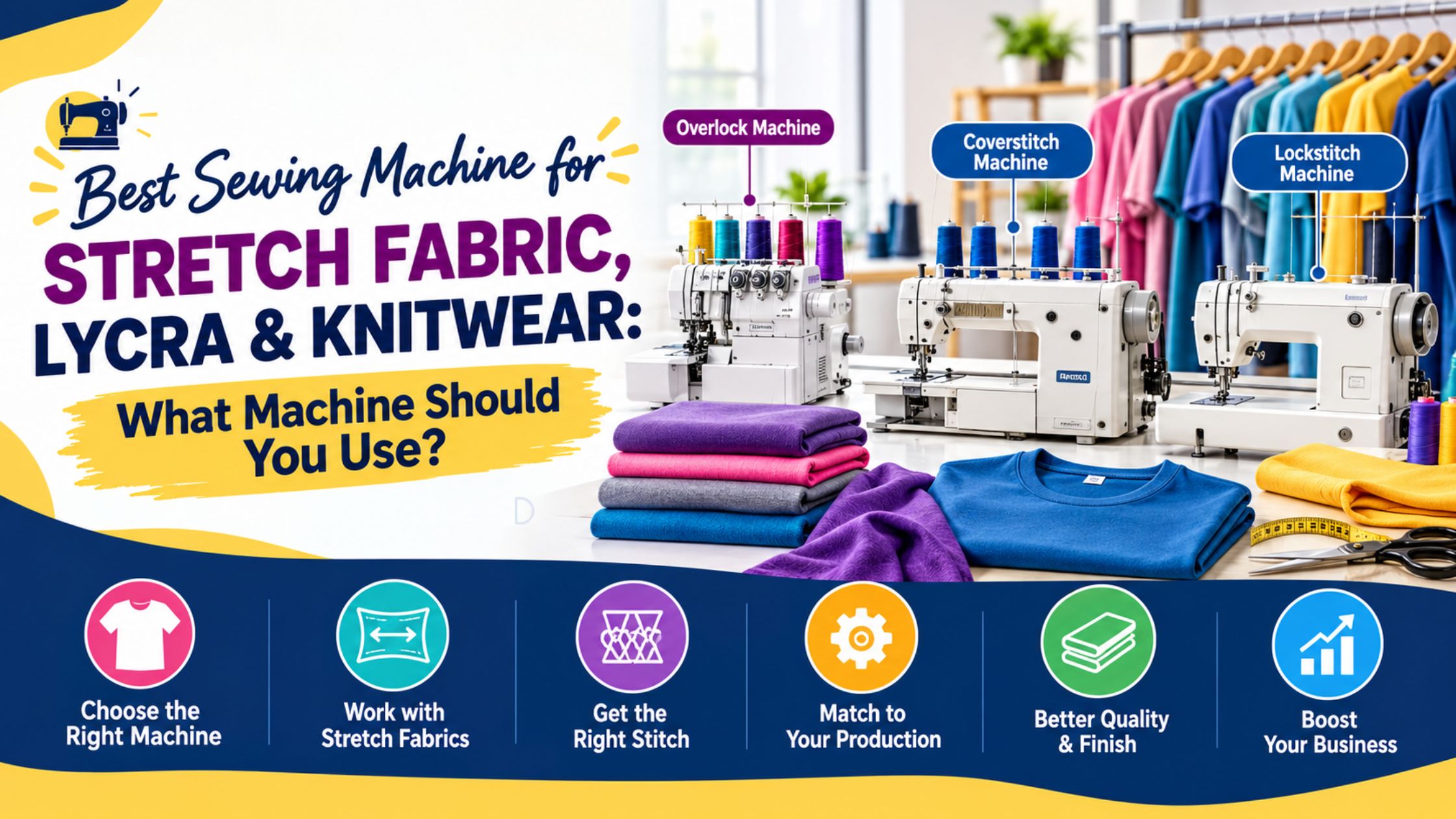
For commercial stretch-fabric and knitwear production, there is no single machine that is “best” for every operation. Overlock machines are commonly used for joining stretch garment panels, while coverstitch/interlock machines are commonly used for hems, bindings and knit finishing. Lockstitch machines remain useful for selected non-stretch or supporting operations.
The correct machine depends on what you are sewing—not simply whether the fabric contains Lycra.
Why Stretch Fabrics Are Difficult to Sew
Stretch fabrics can move differently from woven fabrics while passing through a sewing machine.
Depending on the material, common problems include:
- Wavy seams
- Puckering
- Skipped stitches
- Thread breakage
- Fabric stretching during feeding
- Seam cracking when the garment stretches
- Uneven layers
- Needle damage to the fabric
This is why machine selection must be combined with the correct stitch, feeding, needle, thread and machine adjustment.
Start with the Operation, Not the Fabric Name
“Which sewing machine is best for Lycra?” sounds like a simple question.
But Lycra can appear in:
- T-shirts
- Leggings
- Sportswear
- Innerwear
- Swimwear
- Stretch trousers
- Activewear
- Fashion garments
Those garments do not all use the same seams.
A better sequence is:
Fabric → Garment → Operation → Stitch → Machine
Overlock Machine — Best for Many Knit Assembly Operations
Overlock machines are widely used to assemble knitwear because the stitch formation can accommodate movement while simultaneously controlling the raw fabric edge.
Common uses include:
- T-shirt side seams
- Shoulder seams
- Sleeve joining
- Knit garment assembly
- Stretch garment construction
- Edge finishing
Why differential feed matters
Stretch fabric can become distorted if the layers are fed incorrectly.
On machines equipped with differential feed, the feeding relationship can be adjusted to better control how the material moves through the machine.
This can help reduce problems such as stretched or wavy seams.
Differential feed is therefore much more meaningful for knit production than simply choosing a machine with a high maximum speed.
Coverstitch / Interlock — Best for Knit Hems and Covering
A coverstitch machine is particularly useful when you need a professional stretch hem.
Typical applications include:
- T-shirt bottom hems
- Sleeve hems
- Sportswear hems
- Binding
- Elastic applications
- Knit finishing
- Neckline work depending on configuration
Because the stitch uses looper-based construction rather than a conventional bobbin lockstitch, it can provide the movement required for many stretch-garment finishing operations.
In India, these machines are frequently referred to as interlock machines, although terminology can vary between dealers and manufacturers.
Always confirm the exact stitch and application rather than buying based only on the category name.
What About a Standard Lockstitch Machine?
Industrial lockstitch remains extremely useful.
It provides neat straight stitching and is suitable for many garment operations.
But a standard straight lockstitch is not automatically the right choice for a seam that must stretch substantially with the garment.
It may still be used for:
- Labels
- Non-stretch sections
- Reinforcement
- Selected topstitching
- Waistband-related operations depending on construction
- Sample development
The important question is:
Does this particular seam need to stretch?
If yes, choose the stitch formation accordingly.
Flatlock / Flatseaming for Performance Garments
When people say “stretch fabric machine,” another machine sometimes enters the discussion: flatlock.
True flatlock or flatseaming is especially useful where a low-profile seam is required.
Typical applications can include:
- Sportswear
- Activewear
- Compression clothing
- Innerwear
- Performance garments
- Next-to-skin seams
These seams are useful where bulky seam allowances would be uncomfortable.
However, do not automatically purchase a flatlock machine for every Lycra garment.
Many stretch products can be manufactured using a combination of overlock and coverstitch equipment.

Machine Selection by Garment
Product | Common Machine Requirement |
Cotton-Lycra T-shirt | Overlock + Coverstitch |
Leggings | Overlock + Coverstitch, depending on construction |
Sports T-shirt | Overlock + Coverstitch |
Activewear | Overlock / Coverstitch / Flatseaming depending on design |
Innerwear | Specialized overlock and covering operations |
Stretch fashion garment | Depends on exact seam construction |
Knitwear hemming | Coverstitch / Interlock |
These are production guidelines rather than universal rules. Garment construction should always be reviewed individually.
The Needle Matters Too
Even the correct machine can produce poor results when paired with the wrong needle.
Stretch and knitted materials may require needle types designed to reduce damage to knitted loops or improve stitch formation.
The ideal needle depends on:
- Fabric structure
- Fabric thickness
- Elastic content
- Thread
- Machine class
- Stitch requirement
Do not select a needle based only on fabric marketing names such as “Lycra.”
Thread and Tension Matter
Stretch sewing is a system.
You cannot solve every problem by changing the machine.
Stitch quality also depends on:
- Correct threading
- Thread quality
- Needle condition
- Thread tension
- Presser-foot pressure
- Differential feed
- Stitch length
- Operator handling
This is why machine trials should use the actual production fabric.
Common Mistakes When Sewing Stretch Fabric
Mistake 1: Stretching the Fabric While Sewing
Pulling the material excessively can create wavy or distorted seams.
The machine should feed the material correctly with suitable adjustments.
Mistake 2: Assuming More Threads Means Better
A higher thread count does not automatically make a machine better.
Each stitch configuration exists for a particular construction or finishing requirement.
Mistake 3: Using the Wrong Needle
Skipped stitches or fabric damage may be caused by needle selection or a damaged needle rather than the sewing machine itself.
Mistake 4: Using One Machine for Every Operation
Professional knit garments often use multiple machine classes.
Trying to make every seam with one general-purpose machine may compromise finish or productivity.
Mistake 5: Ignoring Fabric Variation
A cotton jersey and a highly elastic performance knit may behave very differently even if both are described as stretch fabrics.
Which Machine Should a Small Knitwear Unit Buy First?
If the business will primarily manufacture T-shirts and similar basic knitwear, a practical production setup commonly includes:
- Overlock machine
For main garment assembly. - Coverstitch/interlock machine
For bottom and sleeve hems and related knit finishing. - Industrial lockstitch
For supporting straight-stitch operations.
Specialized equipment can then be added according to the garment range and production bottlenecks.
What Should You Check Before Buying?
Take an actual fabric sample and, ideally, a finished garment reference.
Tell the dealer:
- Fabric type
- Fabric GSM if known
- Stretch direction
- Garment type
- Required seam
- Daily production target
- Hem style
- Whether binding is needed
- Current machine setup
Ask for a sewing trial whenever possible.
A successful sample on your actual material tells you more than a specification table alone.
Choosing Stretch-Fabric Machines with Murthy Sewing Machines
Murthy Sewing Machines can help businesses identify the machine type required for each operation instead of recommending one machine simply because a fabric contains Lycra or elastane.
For the best shortlist, bring your fabric and explain the finished garment you want to manufacture.
Current machine specifications, configurations, accessories, availability, pricing, warranty and service conditions should be confirmed for the exact model before purchasing.
Conclusion
The best sewing machine for stretch fabric depends on the operation.
For many knit garments:
- Overlock = garment assembly and edge control
- Coverstitch/interlock = hemming and covering
- Flatlock/flatseaming = specialized low-profile seams
- Lockstitch = supporting straight-stitch operations
When you choose machines around the seam requirement rather than the fabric name alone, production becomes much easier to plan.
FAQs
Which sewing machine is best for Lycra?
For commercial Lycra garments, overlock and coverstitch machines are commonly important, but the final selection depends on the garment and operation.
Can a normal sewing machine sew stretch fabric?
Some stretch fabrics can be sewn on suitable general-purpose machines with the correct setup, but commercial knit production usually benefits from dedicated overlock and coverstitch equipment.
Why do my stretch seams become wavy?
Fabric feeding, differential feed, presser pressure, operator handling, stitch settings and fabric characteristics can all contribute.
Is overlock enough for making T-shirts?
It handles many assembly operations, but professional sleeve and bottom hems normally require a different operation such as coverstitching.
Is interlock the same as coverstitch?
The terms are often used interchangeably in parts of the Indian market, but terminology varies. Always verify the actual stitch and application of the machine.
Do I need flatlock for leggings?
Not automatically. The required machinery depends on how the leggings are constructed and the seam finish desired.
Why does stretch fabric skip stitches?
Possible causes include needle choice, needle condition, threading, timing, tension or material characteristics. Persistent problems should be checked by a technician.
Should I test my fabric before buying an industrial machine?
Yes. Sewing the actual production fabric is one of the most useful ways to confirm whether the configuration suits your application.