


Single-Head vs Double-Head Embroidery Machine: Which Is More Profitable for Your Order Volume?

Buying an embroidery machine is not simply a choice between a smaller machine and a bigger one. It is a business decision that affects how quickly you can complete orders, how much money remains tied up in equipment and whether you can accept larger jobs without delaying your regular customers.
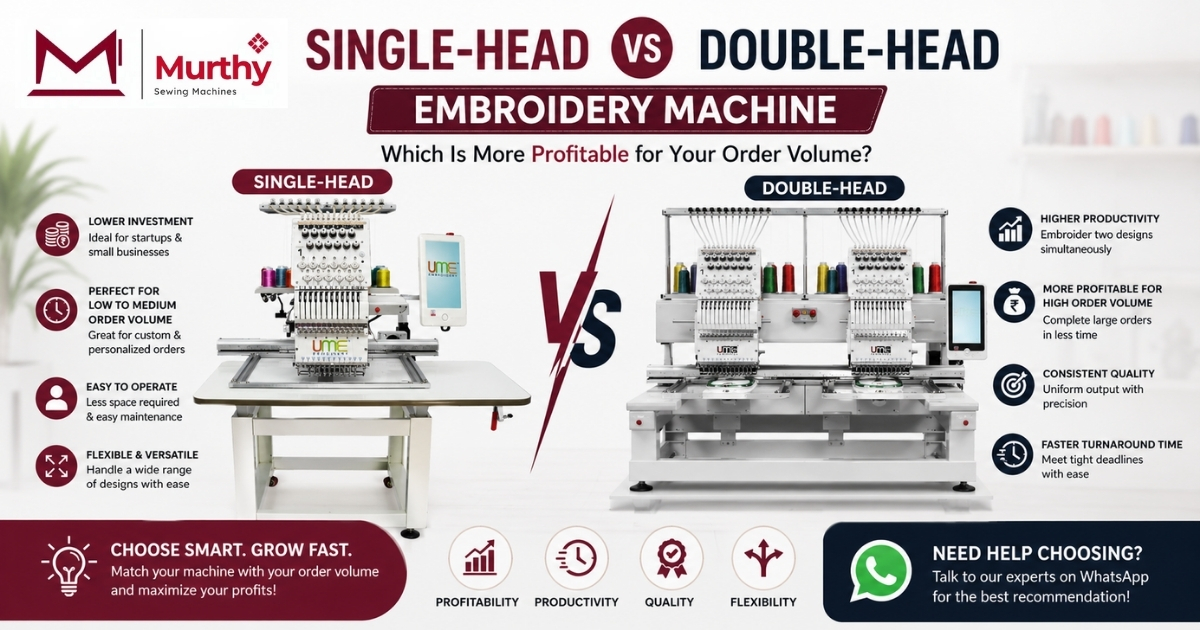
A single-head embroidery machine works on one item during each production cycle. A double-head machine can embroider two matching items during the same cycle. Based on this difference alone, a double-head machine may appear to be the obvious choice for greater profit.
In practice, profitability depends on whether your business can keep both heads productively occupied.
A boutique producing personalized blouses, names, monograms and one-off designs may make better use of a flexible single-head machine. A uniform supplier regularly processing large batches of identical logos may benefit more from a double-head setup.
The right question is therefore not, “Which machine is bigger?” It is:
Which machine matches the volume, variety and frequency of the orders your business actually receives?
This guide compares single-head and double-head embroidery machines based on production requirements, operating costs, workflow and return on investment.
What Is a Single-Head Embroidery Machine?
A single-head embroidery machine has one embroidery head and works on one garment, fabric panel or product at a time.
Depending on the model and compatible attachments, it may be used for:
- Blouse and bridal embroidery
- Personalized garments
- Names and monograms
- School and company logos
- T-shirts and uniforms
- Caps and bags
- Towels and handkerchiefs
- Boutique and designer products
- Samples and short production runs
Modern computerized single-head machines may offer multiple needles, automatic colour changes, design memory, touchscreen controls and support for different hoop sizes.
The main strength of a single-head machine is flexibility. An operator can complete one custom order, change the design and move immediately to a different product without waiting to prepare a second matching item.
Businesses comparing embroidery machines in Chennai can consider single-head models when they need commercial embroidery capabilities but do not yet receive consistent bulk orders.
Who Should Consider a Single-Head Machine?
A single-head embroidery machine is generally suitable for:
- New embroidery businesses
- Home-based customization businesses
- Boutiques handling individual customer orders
- Bridal and designer-wear specialists
- Tailoring shops adding embroidery as a new service
- Businesses producing samples before bulk approval
- Shops with limited workspace
- Companies with changing designs and small quantities
It is also a sensible starting point for entrepreneurs who want to test demand before making a larger investment.
What Is a Double-Head Embroidery Machine?
A double-head embroidery machine has two embroidery heads. It is primarily designed to embroider the same design on two matching products during one production cycle.
If a school-uniform supplier needs the same logo embroidered on a large number of shirts, a double-head machine can process two shirts together. Similarly, it can improve output for repeated corporate logos, workwear, promotional T-shirts, blouse panels or other standardized orders.
This ability can reduce the machine time required per completed piece. However, the benefit is strongest when both heads remain active.
If the business regularly loads only one product, frequently changes designs or receives mostly one-piece orders, much of the second head’s capacity remains unused.
A double-head embroidery machine should therefore be selected for proven production requirements-not simply because it offers higher capacity.
Who Should Consider a Double-Head Machine?
A double-head embroidery machine is generally better suited to:
- School-uniform suppliers
- Corporate-uniform manufacturers
- Garment production units
- Embroidery job-work businesses
- Promotional merchandise suppliers
- Sportswear and team-uniform businesses
- Boutiques receiving repeated bulk orders
- Companies regularly outsourcing embroidery because of limited internal capacity
The strongest candidates are businesses that already have steady order volume, repeat customers and production backlogs.
Single-Head vs Double-Head Embroidery Machine: Key Differences
Comparison | Single-Head Machine | Double-Head Machine |
Items processed per cycle | One item | Two matching items |
Best order type | Custom, mixed and small-batch orders | Repeated and bulk orders |
Design flexibility | Easier to change between individual jobs | Best when both heads run the same job |
Initial investment | Generally lower | Generally higher |
Workspace requirement | More compact | Requires more floor and operating space |
Loading requirement | One item for every cycle | Two prepared items for full utilisation |
Sampling work | Highly practical | Possible, but the second head may remain unused |
Bulk production | Suitable at a smaller scale | More efficient for consistent batches |
Business stage | Startup or growing customization shop | Established or expanding production business |
Financial risk | Lower if order volume is uncertain | Higher if bulk demand is inconsistent |
Growth capacity | May develop a backlog as orders increase | Better capacity for repeat production orders |
Is a Double-Head Machine Twice as Profitable?
Not necessarily.
A double-head machine can embroider two matching items in one cycle, but that does not automatically produce twice the profit. Profit is affected by more than stitching capacity.
You must also consider:
- Time spent preparing garments
- Hooping and alignment
- Design digitizing
- Design loading and colour setup
- Thread and needle changes
- Operator availability
- Thread breaks and stoppages
- Quality inspection
- Rework and rejected pieces
- Customer acquisition
- Seasonal changes in order volume
For example, assume a double-head machine is available for an entire working day, but the business receives only four personalized orders with four different designs. Each design still needs to be loaded, positioned and checked separately. The second head may not contribute much to the day’s production.
Now consider a supplier with 200 school shirts requiring the same logo. Both heads can remain occupied with matching pieces across repeated cycles. In that situation, the double-head machine can deliver a meaningful production advantage.
The second head becomes profitable only when there is enough suitable work to keep it running.
When Is a Single-Head Embroidery Machine More Profitable?
1. Your Orders Are Mostly Customized
Personalized orders frequently involve different names, initials, sizes, placements and colours. A single-head machine allows the operator to move between these jobs without needing a second matching product.
This flexibility is valuable for:
- Customer-name embroidery
- Customized gifts
- Bridal blouses
- Individual uniform replacements
- Monogrammed towels
- Personalized baby products
- One-off designer garments
2. Your Daily Order Volume Is Still Developing
A larger machine does not generate profit simply by being available. When daily order volume is uncertain, a lower-capacity machine may produce a stronger return because more of its available time is used.
A single-head machine can help a new business build its customer base without carrying more capacity than it needs.
3. You Frequently Produce Samples
Uniform suppliers, designers and corporate-merchandise companies often need a sample before receiving approval for the complete order.
A single-head machine is practical for developing these samples, checking thread colours, correcting placement and testing the digitized file before production begins.
4. You Have Limited Space or Staff
A compact setup can be important for home businesses, tailoring shops and small boutiques. A single-head machine may be easier to position, operate and supervise in a smaller workspace.
It also requires only one item to be hooped and prepared for each run.
5. You Want to Test the Embroidery Market
If embroidery is a new addition to an existing tailoring or boutique business, starting with a single-head model can help you understand:
- Which services customers request
- Average order value
- Popular design types
- Monthly production volume
- Seasonal demand
- Consumable expenses
- Operator requirements
Once this data becomes clear, the business can make a better-informed expansion decision.
When Is a Double-Head Embroidery Machine More Profitable?
1. You Regularly Receive Identical Bulk Orders
A double-head machine offers its greatest advantage when the same design must be repeated across many pieces.
Common examples include:
- School uniforms
- Hospital uniforms
- Restaurant uniforms
- Factory workwear
- Corporate shirts
- Sports jerseys
- Event T-shirts
- Promotional caps
- Repeated boutique designs
Because two matching products can be processed together, the business can complete more pieces within its available production hours.
2. Embroidery Has Become Your Production Bottleneck
A machine upgrade should solve a genuine capacity problem.
Signs that your current capacity may be insufficient include:
- Orders are regularly delivered late
- The machine runs for most of the working day
- Customers are being given longer waiting periods
- Bulk orders are being refused
- Embroidery work is frequently outsourced
- Staff are working additional hours to clear backlogs
- Profitable orders are being postponed because the machine is occupied
If the machine is fully utilized but demand continues to grow, a double-head model may help remove the bottleneck.
3. You Have Repeat B2B Customers
Business-to-business orders are often more predictable than individual retail orders. A uniform company, school supplier or promotional-products agency may send repeated batches using the same logo.
This consistency makes it easier to keep both heads active and recover the additional machine investment.
4. Faster Delivery Can Help You Win More Orders
For commercial customers, production time can be as important as price.
If improved capacity allows you to accept urgent orders, reduce delivery times or serve more recurring clients, the machine can contribute to business growth beyond the direct output of each job.
5. You Already Understand Your Production Costs
A double-head investment is easier to justify when the business has records covering:
- Monthly pieces embroidered
- Average stitches per design
- Machine operating hours
- Average selling price
- Direct cost per piece
- Order rejection rate
- Outsourcing expenses
- Orders lost because of limited capacity
These figures provide a more reliable basis for calculating profitability.
How to Match the Machine to Your Order Volume
There is no universal number of orders at which every business must move to a double-head machine. A small logo may take far less machine time than a large, dense bridal design. Ten complex pieces can occupy a machine longer than a much larger order of simple names.
Evaluate order volume using the following factors.
Number of Pieces
Track how many embroidery pieces you complete every day, week and month. Separate one-off customized pieces from identical bulk pieces.
Stitch Count
Higher stitch counts require more machine time. Two businesses completing the same number of garments may have very different production requirements if their average designs contain different stitch counts.
Design Repetition
Repeated designs are better suited to double-head production. Frequent design changes reduce the opportunity to use both heads efficiently.
Machine Utilisation
Record how many hours the existing machine is actively embroidering-not merely switched on.
If a single-head machine has significant unused time, increasing sales may be more important than increasing capacity.
Backlog and Lost Orders
Track orders that are delayed, outsourced or rejected because of limited production capacity. These figures can reveal the financial value of an upgrade.
How to Calculate Which Machine Will Be More Profitable
Instead of choosing based only on the purchase price, compare the financial result each machine can realistically produce.
Step 1: Calculate Contribution Per Piece
Use the following calculation:
Contribution per piece = Selling price – Direct cost per piece
Direct costs can include:
- Garment or fabric cost
- Embroidery thread
- Bobbin thread
- Stabilizer
- Needle usage
- Digitizing cost
- Operator cost
- Electricity allocation
- Packaging
- Expected rework or wastage
Step 2: Estimate Realistic Monthly Output
Do not calculate output using maximum machine speed alone. Allow time for hooping, garment handling, thread changes, design setup, inspection, routine cleaning and stoppages.
Estimate the number of saleable pieces each machine can produce using your actual designs and working hours.
Step 3: Calculate Monthly Contribution
Monthly contribution = Saleable pieces completed × Contribution per piece
Compare the realistic contribution possible with a single-head and double-head setup.
Step 4: Calculate Additional Profit from the Upgrade
Additional monthly contribution = Double-head monthly contribution – Current monthly contribution
This amount should be based only on orders you are reasonably likely to receive and fulfil.
Step 5: Estimate Payback Period
Estimated payback period = Additional investment ÷ Additional monthly contribution
The calculation should also include financing costs, installation requirements, operator training and any additional workspace expenses.
If the additional capacity cannot be filled with confirmed or predictable orders, the estimated payback period may become much longer.
A Practical Order-Based Decision Guide
Choose a Single-Head Machine If:
- Most orders contain one to ten pieces
- Customers request different names or designs
- You specialize in custom or bridal work
- You are starting an embroidery business
- You need a machine for samples and short batches
- Your monthly order volume changes significantly
- Workspace is limited
- Your present capacity is not consistently full
Murthy Sewing Machines offers different computerized single-head options, including machines intended for logos, uniforms, boutique work and larger decorative designs.
Choose a Double-Head Machine If:
- You regularly receive repeated orders
- Both heads can remain active for much of the working day
- Your existing machine is consistently occupied
- You are losing or outsourcing bulk orders
- You serve uniform, workwear or merchandise customers
- Faster delivery would help you accept more business
- You have sufficient workspace and trained staff
- Projected additional profit can recover the investment within an acceptable period
Should You Buy Two Single-Head Machines Instead?
Some growing businesses also compare one double-head machine with two separate single-head machines.
Two single-head machines may allow two operators to run different designs at the same time. This can be useful when the business receives a mixture of custom orders.
However, this approach may involve:
- More floor space
- Two machine setups
- Additional operator attention
- Separate maintenance requirements
- Potentially higher combined operating complexity
A double-head machine is generally better suited to producing two matching items together. Two separate single-head machines may offer greater scheduling flexibility when jobs are unrelated.
The right choice depends on whether your workload is primarily repetitive or varied.
Mistakes to Avoid When Choosing an Embroidery Machine
Buying Capacity Before Building Demand
An underused double-head machine ties up capital without generating enough additional income. Base the decision on order records, not expected demand alone.
Comparing Only the Purchase Price
A lower machine price does not automatically mean a lower cost of ownership. Consider installation, compatible hoops, consumables, training, service access and production reliability.
Assuming Maximum Speed Equals Actual Output
Machine speed is only one part of the production process. Design complexity, stitch density, garment handling and operator efficiency all affect daily output.
Ignoring Embroidery Area
The machine must support the size and placement of the designs your customers request. A machine suitable for shirt logos may not automatically suit large blouse, jacket or decorative-panel designs.
Ignoring Service and Training
Commercial embroidery machines require correct installation, threading, tension adjustment, routine cleaning and operator training. Access to dependable support can reduce avoidable downtime.
Upgrading Without Checking Workflow
Sometimes the machine is not the actual bottleneck. Delays may be caused by slow digitizing, insufficient hoops, poor garment preparation or limited operator availability.
Correct these issues before assuming that additional heads will solve the problem.
Choose an Embroidery Machine Based on Work, Not Head Count
A single-head embroidery machine can be the more profitable choice for a startup, boutique or customization shop handling small quantities and changing designs. It offers flexibility, requires a comparatively controlled investment and allows the business to grow according to genuine customer demand.
A double-head machine becomes more valuable when repeat orders are already available. Uniform suppliers, garment units and embroidery job-work businesses can benefit when both heads remain consistently active and faster production leads to more completed orders.
The goal is not to buy the machine with the greatest capacity. It is to buy the machine whose capacity your business can sell.
Murthy Sewing Machines helps home businesses, boutiques, tailors and commercial production units compare computerized embroidery machines in Chennai based on design type, embroidery area, order volume and expansion plans. Discuss your typical order size and production requirements before selecting a single-head or double-head model.
Frequently Asked Questions
1. Is a double-head embroidery machine twice as fast as a single-head machine?
A double-head machine can embroider two matching items during one production cycle, but overall production may not be exactly twice as fast. Hooping, loading, inspection, design setup, thread changes and operator efficiency also affect the number of finished pieces.
2. Which embroidery machine is better for a new business?
A single-head machine is usually the more practical option when the business is new and order volume is uncertain. It offers flexibility for personalized orders, samples and smaller batches without requiring the business to keep two heads continuously occupied.
3. Can a single-head embroidery machine handle bulk orders?
Yes. A single-head machine can complete bulk orders, but it processes one item during each cycle. It may be suitable for occasional batches, while frequent high-volume orders could create longer production times or backlogs.
4. Which machine is better for school-uniform embroidery?
A double-head machine may be more efficient when the same school logo must be embroidered on a large number of garments. A single-head machine may still be suitable for smaller batches, replacements, samples and personalized student names.
5. Can both heads of a double-head embroidery machine produce different designs?
Double-head machines are mainly selected for coordinated production of the same design on two items. Operating capabilities can vary between models, so buyers should confirm design-control and independent-head features for the particular machine before purchasing.
6. How do I know when to upgrade from a single-head machine?
Consider upgrading when your existing machine is consistently occupied, delivery times are increasing, bulk orders are being outsourced or rejected, and confirmed demand can keep the additional head productive. Use actual production records to calculate the expected return.
7. Is a double-head machine better than purchasing two single-head machines?
A double-head machine is usually more suitable for repeated matching orders. Two separate single-head machines can provide more flexibility when different designs must run simultaneously. Compare your order mix, workspace, staffing and maintenance requirements before deciding.
8. Where can I buy a single-head or double-head embroidery machine in Chennai?
Murthy Sewing Machines supplies computerized embroidery machines for boutiques, tailoring businesses, customization shops and commercial production requirements in Chennai. Buyers can compare models based on embroidery area, needle configuration, production volume and application before purchasing.