


Bobbin Not Winding or Thread Bunching Underneath? Causes & Fixes

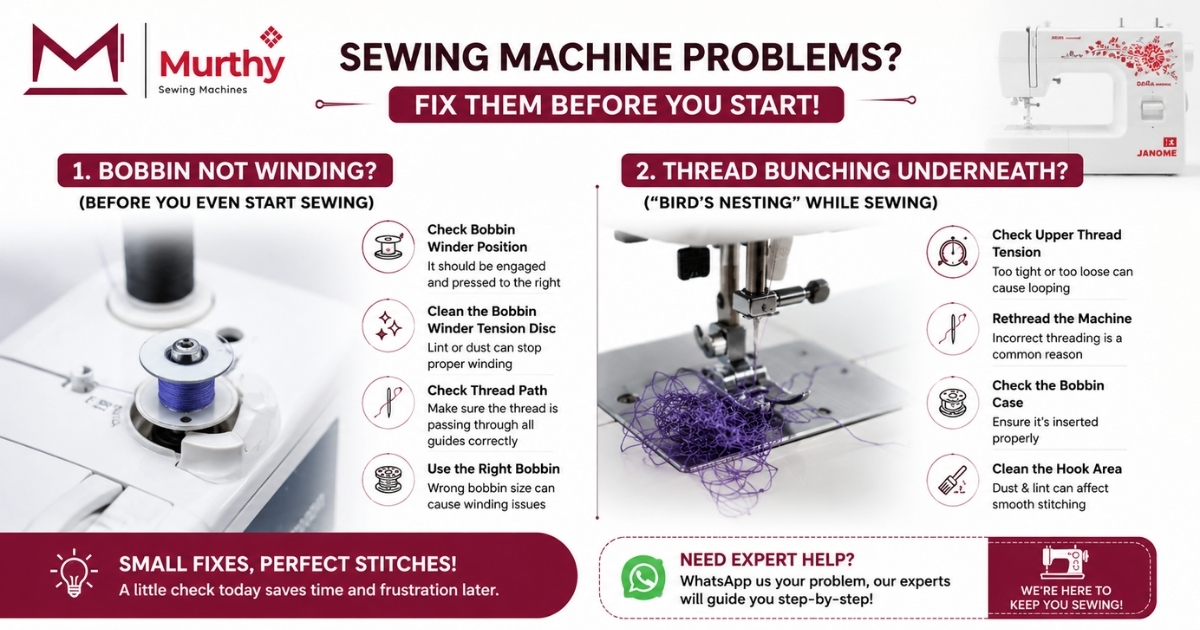
These are two different problems that get mixed up constantly - and fixing one when you actually have the other just wastes your time. Before anything else, figure out which one you're dealing with:
- Bobbin not winding happens before you sew - when you try to wind thread onto an empty bobbin and it comes out loose, uneven, or doesn't wind at all.
- Thread bunching underneath (often called "bird's nesting") happens while you're sewing - the top of your fabric looks fine, but flip it over and there's a tangled mess of loops on the underside.
Here's how to fix both.
Problem 1: Bobbin Won't Wind Properly
Cause: The machine isn't in bobbin-winding mode
Most machines have a stop-motion knob or a small switch that disengages the needle from the main drive while winding a bobbin. If this isn't fully engaged, the needle tries to move while you're winding, and the bobbin either doesn't wind or winds erratically. Check your manual for exactly where this control sits on your model - it's usually on the handwheel itself.
Cause: Thread isn't passing through the bobbin winder tension disc
There's a small tension disc specifically for bobbin winding, separate from your main thread tension dial. If the thread skips over this disc instead of running through it, the bobbin winds loosely or unevenly - the thread will look "fluffy" instead of tightly packed.
Fix: Rethread from the spool, making sure the thread passes through the winder tension disc, not around it. Refer to the threading diagram on your machine - it's usually printed right on the machine body near the spool pin.
Cause: Bobbin isn't seated correctly on the spindle
If the bobbin isn't pushed fully onto the winding spindle, it can wobble while winding, causing uneven thread distribution or the bobbin stopping partway.
Fix: Remove the bobbin, check the spindle for lint or damage, and reseat it firmly until it clicks or sits flush.
Cause: Wrong bobbin type for your machine
Not all bobbins are interchangeable, even between machines that look similar. Metal and plastic bobbins vary by brand and model - using the wrong one can prevent proper winding or cause it to wind off-center.
Fix: Confirm you're using a bobbin genuinely compatible with your exact machine model, not just "a bobbin that fits."
Problem 2: Thread Bunching Underneath While Sewing
This is the more common complaint, and it has more possible causes - so work through these in order, since the first two account for the majority of cases we see.
Cause 1: Top thread was threaded with the presser foot down
This is by far the most common cause, and the easiest to miss. On most machines, the tension discs only fully engage when the presser foot is up. If you thread the machine with the foot down, the thread sits between the discs without being gripped properly - it looks threaded correctly, but there's no real tension on it.
Fix: Raise the presser foot, then rethread the entire top thread path from the spool through the take-up lever to the needle.
Cause 2: Bobbin inserted in the wrong direction
The bobbin has to go into the case so the thread unwinds in a specific direction - usually so that pulling the thread turns the bobbin clockwise (check your manual, as this varies slightly by brand). Insert it backward, and the tension underneath goes completely wrong even if everything else is correct.
Fix: Remove the bobbin case, take the bobbin out, and reinsert it following the direction diagram - usually printed inside the bobbin compartment cover.
Cause 3: Upper thread tension is too loose
If the top tension is too low, the bobbin thread gets pulled up and loops through to the top instead of interlocking neatly at the middle of the fabric layers - this is what actually causes the visible "nest" underneath.
Fix: See our full guide to adjusting sewing machine tension correctly - small adjustments matter here, so change it in small increments and test on scrap fabric each time.
Cause 4: Bobbin case not clicked fully into place
A bobbin case that isn't fully seated can shift slightly during sewing, throwing off the tension inconsistently - which often shows up as bunching that comes and goes rather than being constant.
Fix: Remove the bobbin case completely and reinsert it, making sure you feel or hear it click into its correct position.
Cause 5: Worn or damaged bobbin case
Over time, the tension spring inside a bobbin case wears out, or the case itself picks up small burrs from lint and friction. A damaged bobbin case can cause bunching no matter how correctly everything else is set up, and it's often the reason a problem keeps coming back after you've already tried every other fix.
Fix: Bobbin cases are inexpensive and worth replacing outright if yours is old or the machine sees heavy use - it's a cheap fix that solves a genuinely common cause of recurring bunching. We stock genuine replacement bobbin cases for Usha/Singer/Merritt/SV, Jack and industrial machine sets, and Janome/Singer Fashion machines - check your model and order the matching one.
Cause 6: Lint buildup in the bobbin area
Dust and lint accumulate in the bobbin case and hook race over time, especially with regular use. This buildup interferes with smooth thread movement and tension consistency.
Fix: With the machine off, remove the bobbin case and use a small brush (not compressed air, which can push lint deeper into the mechanism) to clean out the bobbin compartment and surrounding area. Do this every few weeks if you sew regularly.
Cause 7: Needle inserted incorrectly, or the wrong needle for your fabric
A needle inserted backward, bent, or simply too fine for the fabric can cause the top thread to loop incorrectly as it passes through the fabric, which shows up as bunching underneath even though the actual fault is at the needle.
Fix: Check the needle is inserted with the flat side facing the correct direction (usually toward the back, but confirm for your model), and replace it if it's bent, dull, or mismatched to your fabric weight.
When to Stop Troubleshooting and Get It Serviced
If you've worked through all of the above and the bunching keeps returning, the cause may be hook timing - the precise relationship between the needle and the rotating hook that catches the bobbin thread. This isn't something to adjust yourself; it needs a technician's tools and experience to correct, and getting it wrong can cause further damage. This is also worth checking if the problem appeared suddenly after the machine was dropped, jammed, or serviced elsewhere recently. For a broader sense of what else might be going wrong, see our guide to 7 warning signs your sewing machine needs servicing.
Get It Fixed the Easy Way
If you've identified a worn bobbin case, order the matching replacement directly - they're inexpensive and it's usually a five-minute fix:
Browse genuine bobbin cases and spare parts
If you've tried everything here and it's still not resolved, send us a quick description (or a short video, if you can) on WhatsApp and we'll tell you honestly whether it's a quick fix or needs a technician visit.
WhatsApp us: +91 95511 63663
Frequently Asked Questions
Why is my bobbin thread not catching at all?
This usually means the bobbin is inserted backward, the bobbin case isn't seated correctly, or the top thread wasn't threaded with the presser foot up. Work through these three first - they cover the large majority of cases.
Why does my thread bunch up only sometimes, not every time?
Inconsistent bunching often points to a bobbin case that isn't fully seated, lint buildup affecting tension unevenly, or a bobbin case with a worn tension spring. A bobbin case that's always wrong (rather than sometimes) usually points to a threading or insertion mistake instead.
Can I fix bobbin winding problems myself, or do I need a technician?
Most bobbin winding issues - wrong threading, an unseated bobbin, or the machine not being in winding mode - are simple to fix yourself. If the bobbin winds correctly but the machine still won't sew properly, that's a separate issue worth getting checked.
How often should I replace my bobbin case?
There's no fixed schedule, but if you sew regularly and start seeing recurring tension problems that fixes don't resolve, it's often the bobbin case's tension spring wearing out. Since replacements cost very little, it's a reasonable first thing to rule out.
Is thread bunching underneath a sign of a serious machine problem?
Not usually - most cases come down to threading, bobbin insertion, or tension, all of which are simple fixes. It becomes a sign of a bigger issue mainly if it persists after you've correctly ruled out all of the common causes, in which case hook timing is worth having checked.