


Best Embroidery Machine for T-Shirt, Logo & Uniform Embroidery Business

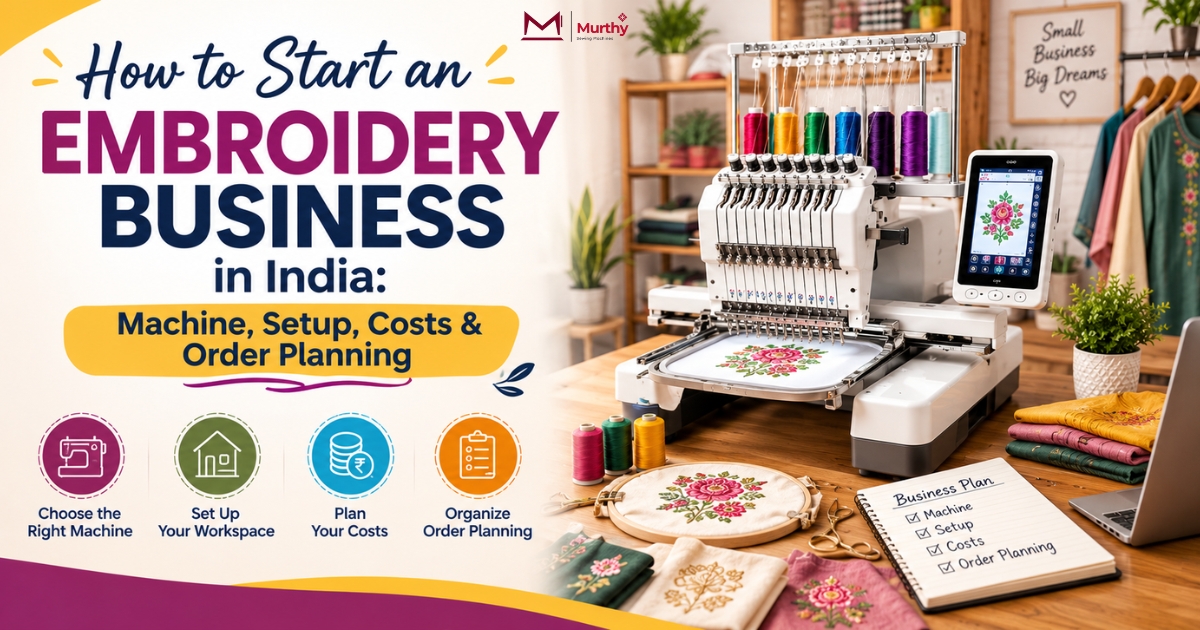
For a business regularly producing T-shirt embroidery, corporate logos, polo shirts and uniforms, a multi-needle single-head embroidery machine is usually one of the most practical machine categories to evaluate.
It offers a good balance between:
- Multi-colour embroidery
- Different customer logos
- Short and medium production runs
- Finished garment embroidery
- Business expansion
- Compact workspace requirements
However, there is no rule saying every commercial T-shirt business must buy a 12-needle or 15-needle machine.
The correct machine depends on:
Products → Number of Colours → Embroidery Size → Daily Orders → Custom vs Bulk Production → Cap Requirements → Available Budget
A 6- or 10-needle professional system may be enough for some businesses, while a 12- or 15-needle commercial machine can provide greater colour flexibility. Businesses handling large quantities of the same uniform logo may benefit more from additional embroidery heads than simply increasing needle count.

Why T-Shirt, Logo and Uniform Embroidery Is a Strong Business Opportunity
Commercial embroidery is widely used for branding clothing.
Potential customers include:
- Companies
- Schools
- Colleges
- Restaurants
- Hotels
- Hospitals
- Factories
- Retail stores
- Sports teams
- Gyms
- Clubs
- Event companies
- Security companies
- Uniform suppliers
The most common products include:
- T-shirts
- Polo shirts
- Formal shirts
- School uniforms
- Corporate uniforms
- Jackets
- Workwear
- Aprons
- Caps
- Sportswear
This makes embroidery attractive because one machine can potentially serve several different markets.
But these applications do not all create the same production requirements.
Producing five customised T-shirts is very different from embroidering 1,000 school uniforms.
Your machine should match the kind of orders you expect to receive.
Start With the Products You Want to Embroider
Before comparing machine specifications, make a product list.
For example:
T-Shirt Business
You may produce:
- Left-chest logos
- Centre-chest embroidery
- Names
- Sports emblems
- Event designs
- Custom artwork
Corporate Uniform Business
You may produce:
- Company logos
- Employee names
- Department names
- Brand marks
School Uniform Business
You may produce:
- School emblems
- Student names
- House names
- Sports-team logos
Promotional Merchandise Business
You may produce:
- Caps
- Polo shirts
- Jackets
- Bags
- Workwear
Each product places different demands on:
- Frames
- Embroidery area
- Needle count
- Machine-arm accessibility
- Stabilisation
- Production capacity

Which Type of Embroidery Machine Should You Consider?
There are three broad equipment levels.
1. Single-Needle Embroidery Machine
A single-needle computerized embroidery machine can be appropriate when:
- Embroidery volume is low
- Orders are mainly personalised
- You are starting from home
- Embroidery is a secondary service
- Designs use limited colours
- You are validating demand
A single-needle machine can still produce good embroidery.
Its limitation appears when commercial multi-colour orders increase.
Every colour change may require more operator involvement.
For occasional orders, this may not matter.
For repeated business production, it can become a bottleneck.
2. Multi-Needle Single-Head Embroidery Machine
For many small commercial embroidery businesses, this is the most important category to evaluate.
A multi-needle machine allows several thread colours to remain loaded and available.
This is valuable for:
- Multi-colour logos
- School emblems
- Corporate branding
- T-shirts
- Polo shirts
- Caps
- Custom uniforms
- Sportswear
Because there is one embroidery head, the machine usually processes one embroidery position at a time.
That makes it particularly flexible for businesses handling:
many different customers + smaller quantities
rather than only large repeated production.
3. Multi-Head Embroidery Machine
Multi-head embroidery machines become increasingly useful when:
- The same design is repeated
- Order quantities are large
- Uniform contracts are frequent
- Production capacity is becoming a bottleneck
- The business has predictable bulk demand
Imagine:
Business A
20 customers
10 different logos
20–30 pieces each
vs
Business B
1 school
1 logo
1,000 shirts
Business A needs flexibility.
Business B needs throughput.
That is why Business A may prefer one or more independent single-head machines, while Business B may benefit more from multiple heads.
Single-Head vs Multi-Head: Which Is Better?
Neither is universally better.
Requirement | Single-Head | Multi-Head |
Custom logos | Excellent | Possible |
One-off personalisation | Excellent | Usually unnecessary |
Small batches | Excellent | May be underutilised |
Different customers | Very flexible | Less flexible |
Sampling | Excellent | Not primary strength |
Large repeated orders | Limited by one head | Strong |
Uniform production | Suitable at lower volumes | Strong for higher volumes |
Workspace | Lower | Higher |
Initial investment | Usually lower | Usually higher |
The deciding factor is:
How much of your work is customised, and how much is repeated?
How Many Needles Do You Need for T-Shirt and Logo Embroidery?
This is where buyers often become confused.
Commercial and professional embroidery machines may be available with:
- 6 needles
- 8 needles
- 9 needles
- 10 needles
- 12 needles
- 15 needles
The number refers primarily to how many thread positions can remain prepared on each embroidery head.
It does not directly mean:
- More garments
- Larger embroidery
- Better quality
- Higher speed
Those are separate specifications.
Is 6 Needles Enough for T-Shirt Embroidery?
For many businesses, yes.
Suppose your normal customer logo uses:
- Red
- Blue
- White
- Black
That is four colours.
A six-needle machine can hold all four simultaneously with additional positions remaining.
Therefore, a business handling relatively simple corporate logos does not automatically need twelve or fifteen needles.
The correct question is:
How many colours are in my normal customer designs?
When Do 10 or 12 Needles Become More Useful?
More needle positions are valuable when your business deals with many different colours throughout the day.
For example:
Customer A
Blue
White
Black
Customer B
Red
Yellow
Green
White
Customer C
Maroon
Gold
Black
Customer D
Orange
Navy
Grey
White
You may not use all colours in one design.
But keeping a broader standard thread palette loaded can reduce repeated rethreading between customers.
That is where higher needle counts improve workflow.
When Does a 15-Needle Machine Make Sense?
A 15-needle embroidery machine can be useful for businesses handling:
- Many different corporate logos
- Detailed sports emblems
- Complex multi-colour designs
- Many customer orders each day
- A large standard thread palette
But a 15-needle machine is not automatically more profitable than a 12-needle machine.
If most of your orders use only four colours, the additional needle positions may rarely affect production.
Needle Count vs Head Count
This distinction is essential.
Needle Count
Think:
Colours Ready
Head Count
Think:
Items Produced Simultaneously
For example:
15-Needle Single-Head
15 thread positions
1 embroidery station
12-Needle Double-Head
12 thread positions per head
2 embroidery stations
If you produce hundreds of identical four-colour school logos, the extra embroidery head may improve capacity by more than three extra needle positions.
Which Machine Is Best for T-Shirt Embroidery?
For regular commercial T-shirt embroidery, evaluate a multi-needle single-head machine first unless your production volume clearly requires more heads.
Important requirements include:
- Reliable multi-colour operation
- Suitable embroidery area
- Finished-garment accessibility
- Compatible hoops
- Automatic trimming where available
- Thread-break monitoring where available
- Easy design transfer
- Good positioning
- Technical support
But T-shirt quality depends on much more than the machine.
Why T-Shirts Can Be Difficult to Embroider
Most T-shirts are made from knitted fabric.
Knit fabric can:
- Stretch
- Move
- Distort
- Pucker
during embroidery.
Common problems include:
- Wavy embroidery
- Puckering
- Misaligned outlines
- Distorted lettering
- Fabric stretching around the logo
- Poor registration
These problems are often blamed entirely on the machine.
In reality, embroidery quality depends on the complete setup.

T-Shirt Embroidery Quality Formula
For clean T-shirt embroidery, you need:
Good Digitizing
- Correct Stabilizer
- Suitable Needle
- Proper Hooping
- Correct Thread/Tension
- Suitable Machine Setup
A more expensive embroidery machine cannot compensate for incorrect preparation.
Stabilizer Is Critical for T-Shirt Embroidery
Stabilizer supports the fabric while the embroidery is formed.
Because T-shirt fabric stretches, proper support helps prevent:
- Distortion
- Puckering
- Poor registration
The appropriate stabilizer depends on:
- Fabric weight
- Design density
- Embroidery size
- Garment construction
Do not choose stabilizer only by habit.
Match it to the product and design.
Do Not Stretch the T-Shirt Excessively in the Hoop
A common mistake is pulling knit fabric tightly while hooping.
The garment may look smooth while stretched.
But once removed from the hoop, the fabric relaxes.
This can make the embroidery pucker.
The garment should be held securely without unnecessary distortion.
Embroidery Digitizing for T-Shirts
Digitizing controls how the machine builds the design.
Important factors include:
- Stitch direction
- Underlay
- Density
- Pull compensation
- Stitch sequence
- Small lettering
- Trimming
- Colour order
A logo digitized for a heavy jacket may not behave the same way on lightweight T-shirt jersey.
Commercial embroidery files should be prepared for the actual product.
Which Machine Is Best for Corporate Logo Embroidery?
Corporate logo work usually involves:
- Small chest embroidery
- Multi-colour logos
- Small lettering
- Repeated branding
- Several different customers
A multi-needle single-head system is particularly attractive because it provides:
- Colour flexibility
- Quick job changes
- Custom-order capability
- Professional finished-garment embroidery
As the business develops larger repeated contracts, additional machine capacity may become necessary.
Small Lettering Is a Major Part of Corporate Embroidery
Corporate logos frequently contain:
- Brand names
- Taglines
- Initials
- Department names
Embroidery has physical limitations.
Very small text cannot always reproduce exactly like printed artwork.
Before accepting a difficult logo:
- Digitize it properly.
- Stitch a test sample.
- Check readability.
- Confirm size.
- Get customer approval.
Do not promise perfect reproduction from a screen image alone.
Which Machine Is Best for School Uniform Embroidery?
School uniform work has a different order pattern.
The same emblem may be embroidered repeatedly across:
- Shirts
- T-shirts
- Blazers
- Sportswear
A multi-needle single-head machine can be practical for smaller school or uniform orders.
As orders increase, number of heads becomes increasingly important.
For example:
20–50 Uniforms
Single-head may be practical.
100–500 Uniforms
Capacity should be calculated carefully.
Continuous Large Contracts
Double-head or multi-head equipment may become commercially valuable.
The exact breakpoint depends on design time, cycle time and available working hours.
School Uniform Embroidery Needs Consistency
If 500 shirts carry one school emblem, the last piece should match the first as closely as possible.
Create standard production records for:
- Logo dimensions
- Thread colours
- Placement
- Stabilizer
- Frame
- Stitch file
- Machine settings where appropriate
This makes repeat orders easier.
Which Machine Is Best for Corporate Uniforms?
Corporate uniform businesses may embroider the same brand across:
- Polo shirts
- Formal shirts
- Jackets
- Aprons
- Caps
- Workwear
The embroidery machine should therefore handle different finished products comfortably.
A useful commercial setup should be selected according to:
- Garment accessibility
- Frame options
- Cap requirements
- Logo dimensions
- Material range
Do You Need a Machine That Can Embroider Caps?
If your customers include:
- Companies
- Sports teams
- Events
- Promotional businesses
- Colleges
caps can become an important additional product.
But cap embroidery needs to be verified separately.
Ask:
- Is a cap frame available?
- Is a cap driver required?
- What cap embroidery area is supported?
- Which cap constructions are suitable?
- Are accessories included?
- Is training available?
Never assume cap capability merely because the machine is commercial.
Finished Garment Embroidery Is Important
Commercial embroidery businesses normally work with already-manufactured products.
These may include:
- T-shirts
- Polo shirts
- Shirts
- Caps
- Bags
- Jackets
The machine needs to allow appropriate access to the embroidery area.
Cylinder-type/free-arm commercial configurations can be particularly useful for finished products.
When evaluating a machine, physically consider how the item will be loaded.
Embroidery Area: Do Not Ignore This Specification
Needle count receives a lot of attention, but embroidery field can be more important.
Small Chest Logo Business
You may primarily produce:
- 70 mm logos
- 100 mm logos
- Names
A very large field may not be essential.
Mixed Customisation Business
Customers may request:
- Chest logos
- Large artwork
- Bags
- Jacket backs
A larger embroidery area increases flexibility.
Large Design Business
If you offer:
- Jacket backs
- Large sweatshirt embroidery
- Large patches
- Decorative panels
then maximum embroidery area becomes a major buying criterion.
Which Embroidery Field Do You Need?
Do not buy based on the largest possible field simply because it sounds better.
Ask:
What is the largest design customers will realistically order?
Then leave reasonable room for future expansion.
A large embroidery field is valuable only if your products use it.
What Features Should You Check Before Buying?
Use this checklist.
Feature | Why It Matters |
Needle count | Number of ready thread positions |
Head count | Production throughput |
Embroidery area | Maximum design size |
Finished-garment handling | T-shirts, shirts, bags |
Cap system | Expands product offering |
Hoops and frames | Determines supported applications |
Automatic trimming | Reduces some manual finishing |
Thread-break detection | Helps monitor production |
Design transfer | Affects workflow |
Positioning aids | Important for logo placement |
Screen/editing controls | Helps routine setup |
Machine footprint | Important for workspace |
Training | Important for new operators |
Service support | Reduces downtime risk |
Spare-parts availability | Important for long-term use |
Exact features vary by machine.
Always compare the actual models rather than assuming every commercial machine includes the same functions.
Is Maximum Stitching Speed the Most Important Specification?
No.
Machine speed is useful, but business productivity is measured in:
Good Finished Garments Per Day
not:
Maximum Stitches Per Minute
Actual production includes:
- Garment preparation
- Stabilizer preparation
- Hooping
- Design loading
- Positioning
- Embroidery
- Bobbin changes
- Thread issues
- Unloading
- Finishing
- Inspection
Calculate Real Production Capacity
Suppose your logo takes:
7 minutes to embroider
But each garment also requires:
- 2 minutes preparation
- 1 minute loading/positioning
- 1 minute unloading/finishing
Your approximate complete cycle becomes:
11 minutes
not seven.
Use:
Available Productive Minutes ÷ Complete Cycle Time = Approximate Capacity
Then leave room for downtime and production interruptions.

Example: T-Shirt Customisation Startup
Suppose your business handles:
- 10–30 garments per order
- Different customer logos
- 3–8 colours
- T-shirts and polos
- Occasional caps
The key requirement is:
flexibility
A multi-needle single-head machine is often a sensible configuration to investigate.
You can change customer designs without committing to a large multi-head production system.
Example: Corporate Uniform Supplier
Suppose you regularly receive:
- 100–300 polo shirts
- Same logo
- Same placement
- Repeat contracts
Now productivity becomes more important.
A single-head system can still perform the work, but you should calculate whether delivery requirements justify:
- Another single-head machine
- Double-head machine
- Multi-head system
Example: School Uniform Manufacturer
Suppose you need to embroider:
1,000 shirts with one school emblem
The logo uses only four colours.
Would you benefit more from:
Moving from 12 needles to 15?
or
Increasing the number of embroidery heads?
In most production scenarios like this, head count deserves serious consideration because the same four-colour design is being repeated.
This demonstrates why needle count alone cannot determine commercial productivity.
Example: Custom Corporate Embroidery Shop
Now suppose you work with:
- 20 companies
- Different logos
- Different colours
- Different garments
You rarely produce hundreds of one design.
Here, a flexible single-head machine with enough needle positions can be more useful than a large synchronized multi-head system.
Another Single-Head vs Double-Head: How Should You Expand?
When your first machine becomes busy, identify the real bottleneck.
Add Another Single-Head If:
You frequently need to run:
- Two different customer designs
- Sampling alongside production
- Different garment types
- Personalised orders
This gives you two independent production stations.
Consider Double-Head If:
Most orders are:
- Same logo
- Same product
- Larger quantities
This gives you greater repeated-production capability.
Which Embroidery Machine Is Best by Business Type?
Business Type | Machine Direction to Evaluate |
Occasional T-shirt personalisation | Single-needle / compact professional |
Home customisation startup | Compact multi-needle |
T-shirt embroidery shop | Multi-needle single-head |
Corporate logo service | Multi-needle single-head |
School uniform startup | Multi-needle single-head |
Growing uniform business | Additional head capacity |
Corporate apparel supplier | Commercial multi-needle |
Cap + garment business | Machine with verified cap system |
High-volume uniform production | Double/multi-head |
Large contract embroidery unit | Multi-head production system |
This table is a starting point rather than a substitute for evaluating the exact workload.
Should You Choose 6, 10, 12 or 15 Needles?
Use this practical framework.
6 Needles
Consider when:
- Logos are relatively simple
- Typical colour count is limited
- Business volume is moderate
- Compact professional equipment fits your needs
10 Needles
Consider when:
- You want greater colour flexibility
- Corporate/logo work is regular
- You handle different customers
12 Needles
Consider when:
- Commercial multi-colour work is a major focus
- You want a broader permanent thread palette
- Different brand logos arrive regularly
15 Needles
Consider when:
- Colour variety is high
- Frequent rethreading would slow production
- Complex multi-colour work is common
- The rest of the machine specification also suits your business
There is no universal minimum needle count for a commercial T-shirt business.
Common Buying Mistakes
Mistake 1 - Believing Every Business Needs 12 or 15 Needles
Your actual designs should decide.
Mistake 2 - Confusing Needles With Heads
More needles do not mean more garments being embroidered simultaneously.
Mistake 3 - Choosing Only by Maximum Speed
Complete cycle time matters more.
Mistake 4 - Ignoring Embroidery Area
The machine may not support future design sizes.
Mistake 5 - Assuming Every Machine Can Embroider Caps
Verify the actual cap system.
Mistake 6 - Ignoring Knit Fabric Behaviour
T-shirts require correct stabilisation and digitizing.
Mistake 7 - Ignoring Finished-Garment Accessibility
A machine that works well on flat fabric may not be equally convenient for every finished product.
Mistake 8 - Buying Multi-Head Capacity Without Orders
Unused heads tie up capital.
Mistake 9 - Buying Too Little Capacity for Existing Contracts
If bulk orders are already confirmed, undersizing equipment can create delivery problems.
Mistake 10 - Ignoring Service Support
Downtime directly affects revenue.
What Should You Take for a Machine Demonstration?
Do not evaluate the machine only with the dealer's demonstration design.
Where possible, bring:
- Your normal T-shirt
- Polo shirt
- School uniform sample
- Difficult logo
- Small-lettering logo
- Multi-colour logo
- Cap if relevant
Ask for a realistic demonstration.
Observe:
- Hooping
- Loading
- Positioning
- Thread changes
- Small lettering
- Fabric behaviour
- Finished quality
A real customer-type sample gives you much more useful information than a decorative demo design.

Buyer Decision Checklist
Before selecting a machine, answer these questions:
Products
- T-shirts?
- Polo shirts?
- School uniforms?
- Corporate shirts?
- Caps?
- Jackets?
- Bags?
Designs
- Small chest logos?
- Large designs?
- Names?
- Multi-colour logos?
- Small lettering?
Volume
- Pieces per day?
- Average order size?
- Peak-season volume?
Order Type
- Mostly different customer jobs?
- Mostly repeated logos?
Machine
- Number of needles?
- Number of heads?
- Embroidery area?
- Cap compatibility?
- Suitable frames?
Business
- Available workspace?
- Operator skill?
- Service support?
- Expansion plans?
- Investment range?
If these questions are clear, choosing the machine becomes much easier.
Expert Recommendation
For a new or growing business focused on:
- T-shirts
- Polo shirts
- Corporate logos
- School uniforms
- Custom garments
- Smaller and medium production runs
a multi-needle single-head embroidery machine is one of the strongest configurations to evaluate.
It provides a useful balance between:
Colour Flexibility + Product Variety + Commercial Capability + Workspace Efficiency
But do not buy based only on the number of needles.
Evaluate the complete machine:
Needles
- Heads
- Embroidery Area
- Frames
- Finished-Garment Capability
- Cap System
- Workflow Features
- Service Support
If your business already has regular high-volume uniform contracts, production capacity may be more important than simply adding three more needle positions.
Choosing an Embroidery Machine with Murthy Sewing Machines
Murthy Sewing Machines can help businesses evaluate embroidery machines according to actual production requirements.
Before enquiring, share:
- Products you want to embroider
- Typical order quantity
- Approximate pieces per day
- Typical number of colours
- Largest design size
- Whether caps are required
- Whether jobs are customised or repeated
- Existing machine setup
- Available workspace
- Approximate investment range
This makes it easier to identify whether your business should evaluate:
- Single-needle embroidery
- Multi-needle single-head embroidery
- Double-head embroidery
- Multi-head production equipment
Exact machine specifications, accessories, current stock, pricing, warranty and service terms should be confirmed for the selected machine before purchase.
Conclusion
The best embroidery machine for a T-shirt, logo or uniform business is not automatically the machine with:
- The most needles
- The largest frame
- The highest speed
- The highest price
It is the machine that matches your real order flow.
Remember:
Needles → Colour Flexibility
Heads → Production Capacity
Embroidery Area → Design Size
Frames → Product Capability
Digitizing + Stabilisation → Embroidery Quality
For businesses handling many different customer logos, a multi-needle single-head system often provides an excellent starting point.
For businesses handling large repeated uniform orders, additional heads can become much more valuable.
Buy for the work you expect to produce—not merely for the specification sheet.
Frequently Asked Questions
1. Which embroidery machine is best for a T-shirt business?
For regular commercial T-shirt embroidery, a multi-needle single-head professional or commercial embroidery machine is generally a strong category to evaluate. The exact machine should be selected according to number of colours, embroidery area, daily production, cap requirements and budget.
2. How many needles do I need for T-shirt logo embroidery?
There is no fixed minimum. A 6-needle machine can handle many multi-colour logos, while 10-, 12- or 15-needle machines provide progressively more pre-threaded colour positions. Choose according to the actual designs and colour changes your business handles.
3. Is a 12-needle embroidery machine good for a uniform business?
Yes, a 12-needle machine can provide substantial colour flexibility for school and corporate logos. However, for large repeated uniform orders, number of heads may become more important than increasing needle count.
4. Is a 15-needle machine better for corporate logos?
It can be useful for businesses handling many different logo colours because more threads can remain ready. It is not automatically better if your normal designs use only a few colours.
5. Can the same embroidery machine embroider T-shirts and caps?
Some machines support both T-shirt and cap embroidery with appropriate accessories. Confirm cap-frame, cap-driver and embroidery-area compatibility for the exact model before buying.
6. Why does embroidery pucker on T-shirts?
Common causes include insufficient stabilisation, excessive stretching during hooping, unsuitable digitizing, excessive density, tension problems or an inappropriate needle/setup. T-shirt knit fabric needs proper support.
7. Which embroidery machine is suitable for school uniforms?
A multi-needle single-head machine can suit small and medium school-uniform production. Businesses handling large repeated quantities should also evaluate double-head or multi-head production capacity.
8. Is a single-head machine enough for corporate embroidery?
For many small and medium custom embroidery businesses, yes. Single-head equipment provides strong flexibility for different customer logos. Higher-capacity equipment becomes relevant as repeated order volume grows.
9. Is embroidery better than printing for company uniforms?
Neither method is universally better. Embroidery is widely used for professional logos on polo shirts, formal shirts, jackets, caps and uniforms, while printing can be more suitable for larger artwork or certain graphic designs. Some customisation businesses offer both.
10. Where can I buy a commercial embroidery machine for T-shirts and uniforms in Chennai?
Murthy Sewing Machines can help customers compare embroidery machines according to T-shirt, logo, uniform and other commercial embroidery requirements. Current models, specifications, pricing, accessories and availability should be confirmed during enquiry.