


12-Needle vs 15-Needle Embroidery Machine: What Difference Does Needle Count Actually Make?

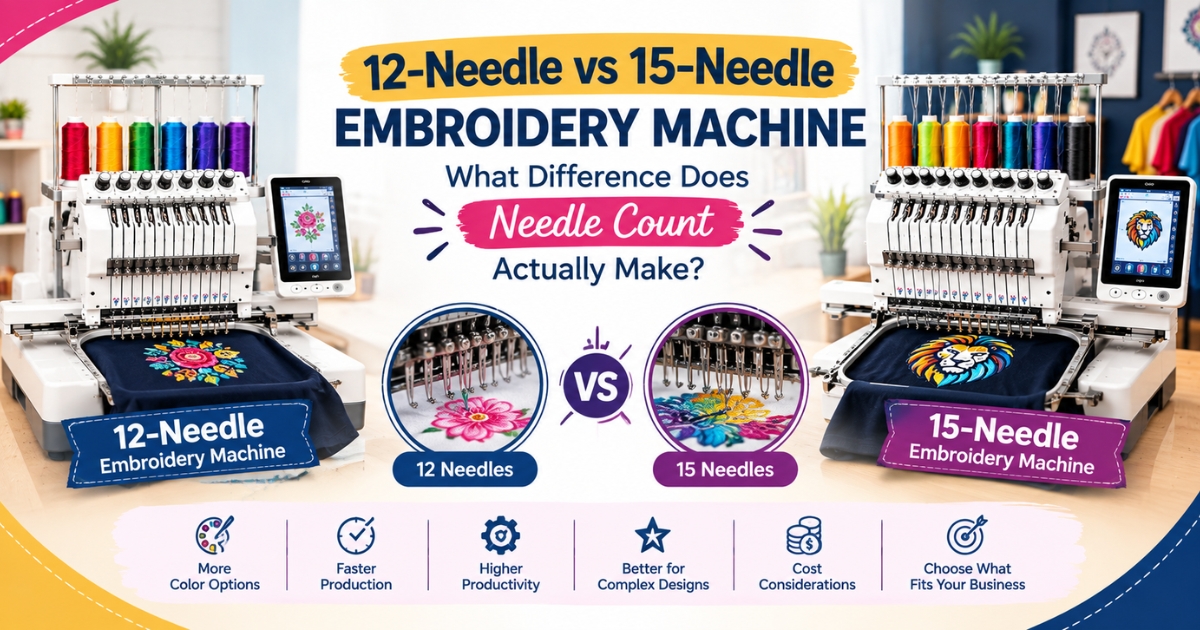
The main difference between a 12-needle and 15-needle embroidery machine is the number of thread colours that can remain loaded and ready on each embroidery head.
A 12-needle machine provides 12 needle positions, while a 15-needle machine provides 15. That gives the 15-needle configuration three additional pre-threaded colour positions—25% more than a 12-needle setup.
However, that does not automatically mean a 15-needle machine stitches faster, produces more garments at once, has a larger embroidery area or creates better embroidery.
Those characteristics depend on the specific machine model, number of heads, mechanical design, embroidery field, software, frames and other specifications.
For many small and medium embroidery businesses, 12 needles can provide more than enough colour flexibility. A 15-needle machine becomes particularly useful when you frequently work with colour-heavy logos, many different customer designs or want to keep more commonly used thread colours permanently loaded.
The right question is therefore not:
"Is 15 better than 12?"
It is:
"Will my business actually use those three additional needle positions?"
Why Embroidery Businesses Compare 12-Needle and 15-Needle Machines
Once an embroidery business moves beyond a home single-needle machine, needle count becomes one of the most visible specifications.
You may see machines advertised as:
- 6 needle
- 8 needle
- 9 needle
- 10 needle
- 12 needle
- 15 needle
At first glance, the buying decision seems obvious.
If fifteen is greater than twelve, a fifteen-needle machine must be better.
But commercial embroidery does not work that simply.
The number of needles affects one important part of the production workflow:
how many thread colours can remain prepared on each embroidery head.
It does not independently determine everything else about the machine.
Understanding that distinction can prevent you from paying for capacity that you will rarely use—or buying too little flexibility for the type of orders your business handles.
What Does "12-Needle Embroidery Machine" Actually Mean?
A 12-needle embroidery machine generally provides twelve needle positions on each embroidery head.
Each needle can normally be threaded with a different colour.
For example:
- Black
- White
- Red
- Royal blue
- Navy
- Yellow
- Green
- Orange
- Grey
- Pink
- Gold
- Brown
The exact colours are entirely up to the operator and the work being produced.
If a design uses six of these colours, the machine can select the required prepared needles according to the embroidery program and machine configuration.
This reduces the need to manually replace thread every time the design requires another already-loaded colour.
What Does "15-Needle Embroidery Machine" Mean?
The principle is the same.
A 15-needle machine offers fifteen available needle positions per head.
Using the previous example, the business might add:
- Purple
- Maroon
- Light blue
Those extra positions allow three more thread colours to remain ready.
That is the fundamental advantage.
12 Needles
12 prepared thread positions.
15 Needles
15 prepared thread positions.
Difference
3 additional positions.
Or, viewed another way:
15 needles provide 25% more needle positions than 12 needles.
But whether that 25% increase produces any meaningful business advantage depends entirely on your order mix.
12-Needle vs 15-Needle Embroidery Machine: Quick Comparison
Factor | 12-Needle | 15-Needle |
Available needle positions | 12 | 15 |
Additional positions | — | 3 more |
Colour flexibility | High | Higher |
Suitable for multi-colour logos | Yes | Yes |
Frequent design changes | Good | Greater flexibility |
Common thread colours permanently loaded | Good | More capacity |
Automatically stitches faster | No | No |
Automatically has larger embroidery area | No | No |
Automatically produces more pieces simultaneously | No | No |
Automatically gives better stitch quality | No | No |
Best for every business | No | No |
This table highlights the central point of the comparison:
Needle count affects colour-management capacity.
It should not be confused with other machine specifications.
Does a 15-Needle Machine Embroider Faster Than a 12-Needle Machine?
Not necessarily.
This is one of the biggest misunderstandings surrounding commercial embroidery machines.
Machine speed is determined by the specifications and design of the particular model.
A manufacturer can produce:
- A 12-needle machine capable of a certain maximum speed
- A 15-needle machine capable of the same speed
- Another 12-needle machine with different performance
- Another 15-needle model with different performance
Therefore:
15 needles ≠ automatically higher stitching speed.
Where the 15-needle configuration can save time is in colour management.
For example, if a new customer design requires three colours that are not currently loaded on your 12-needle setup, you may need to replace some threads.
If those colours are already sitting on additional positions in a 15-needle machine, you can reduce some rethreading.
That is a workflow advantage—not necessarily an embroidery-speed advantage.
Does a 15-Needle Machine Produce More Garments?
Not because it has 15 needles.
Production quantity is more strongly affected by factors such as:
- Number of embroidery heads
- Design stitch count
- Machine operating speed
- Colour-change frequency
- Trims
- Garment handling
- Hooping time
- Bobbin changes
- Operator efficiency
- Design setup
- Machine downtime
This is why buyers must understand the difference between:
Needle Count
How many needle/thread positions are available per embroidery head.
and
Head Count
How many embroidery stations the machine has.
Needle Count vs Head Count
Consider these two machines:
Machine A
15 needles
1 head
Machine B
12 needles
2 heads
Machine A provides more thread positions per head.
Machine B provides two embroidery stations.
If you need to produce a large quantity of identical polo-shirt logos, Machine B's second embroidery head may have a much greater effect on throughput than Machine A's three additional needle positions.
So remember:
Needles = Colour Flexibility
Heads = Simultaneous Production Capacity
This distinction is critical when buying embroidery equipment for business.
Does a 15-Needle Machine Have a Larger Embroidery Area?
Not automatically.
Embroidery area is a separate machine specification.
Depending on the models being compared, you might find:
- A 12-needle machine with a large field
- A 15-needle machine with a smaller field
- Both configurations with the same field
- Different machines with completely different frame systems
If your business needs to produce:
- Jacket-back embroidery
- Large patches
- Decorative garment panels
- Large bag designs
then embroidery area may matter considerably more than the difference between 12 and 15 needles.
Never assume that more needles means a larger embroidery field.
Does a 15-Needle Machine Give Better Embroidery Quality?
Again, not simply because it has more needles.
Embroidery quality depends on the complete production system.
Important factors include:
- Machine construction
- Mechanical condition
- Needle
- Thread
- Bobbin tension
- Upper-thread tension
- Fabric
- Stabilizer
- Hooping
- Digitizing
- Design density
- Stitch settings
- Operator experience
- Maintenance
A well-configured 12-needle machine with good digitizing can produce much better results than a poorly configured 15-needle machine.
Do not confuse colour capacity with stitch quality.

Where the Extra Three Needles Actually Help
Now we come to the real business advantage of a 15-needle machine.
Imagine your embroidery shop regularly uses these colours:
- Black
- White
- Red
- Navy
- Royal blue
- Yellow
- Green
- Grey
- Orange
- Pink
- Gold
- Maroon
A 12-needle machine can keep all twelve prepared.
But then a customer arrives with a logo using:
- Purple
- Sky blue
- Beige
You need to decide which existing colours to remove and replace.
On a 15-needle setup, those additional colours could potentially remain prepared as well.
The advantage therefore becomes:
fewer routine thread substitutions between varied jobs.
Example 1: School Uniform Embroidery
Suppose your business mainly embroiders three school logos.
School A uses:
- Blue
- White
- Red
School B uses:
- Green
- Yellow
- White
School C uses:
- Maroon
- Gold
- White
Even allowing for additional common colours, a 12-needle setup may provide plenty of capacity.
In this scenario, moving from 12 to 15 needles may not dramatically change production.
Your bigger considerations may be:
- Number of heads
- Hooping efficiency
- Machine reliability
- Delivery capacity
Example 2: Corporate Logo Embroidery Shop
Now imagine you serve:
- Restaurants
- Hotels
- Gyms
- Startups
- Factories
- Schools
- Sports clubs
- Retail brands
Every customer has a different logo.
Throughout one day you may require:
- Red
- Orange
- Yellow
- Lime
- Green
- Turquoise
- Royal blue
- Navy
- Purple
- Pink
- Maroon
- Brown
- Grey
- Black
- White
A 15-needle machine can keep a broader colour palette prepared.
That does not make the embroidery itself inherently faster.
But it can reduce rethreading and improve job-change efficiency.
For a high-variety customisation business, that matters.
Example 3: One Large Uniform Contract
Suppose your machine spends most of the week embroidering a four-colour company logo onto 1,000 polo shirts.
Only four colours are required.
In this situation:
12 needles vs 15 needles probably matters much less than head count and workflow efficiency.
Three additional unused thread positions will not produce the order faster simply by existing.
A multi-head machine may have a much bigger effect on capacity.
Example 4: Complex Sports Logos
Sports crests and club logos can involve:
- Several colours
- Outlines
- Small lettering
- Multiple shades
A 15-needle configuration can be useful if your normal designs regularly approach or exceed the colours you want permanently loaded.
However, even here, design quality depends heavily on proper digitizing.
More needles cannot fix a poorly digitized logo.
Do Embroidery Designs Really Use 12 or 15 Colours?
Some do.
Many do not.
Typical commercial logo work may use significantly fewer colours.
That is why needle count should be evaluated against your actual customer artwork rather than hypothetical maximum designs.
Review your recent jobs.
How many required:
- 1–3 colours?
- 4–6 colours?
- 7–9 colours?
- 10–12 colours?
- More than 12?
That information is far more valuable than simply reading a brochure.
Think Beyond Colours Per Design
There is another important consideration.
A design does not need fifteen colours for fifteen needles to be useful.
Suppose every design uses only five colours.
But you handle twenty different customers every day.
Customer A may need:
Red + Blue + White + Grey + Black.
Customer B may need:
Green + Yellow + White + Navy + Gold.
Customer C may need:
Orange + Maroon + Beige + Brown + White.
Keeping more commonly used colours installed can still save thread changes between jobs, even though each individual design uses only five colours.
This is where 15 needles can become useful for high-variety customisation businesses.

12 Needles Can Already Be a Lot of Colour Capacity
It is equally important not to underestimate 12 needles.
Twelve available thread positions provide substantial flexibility for:
- Company logos
- School emblems
- Polo shirts
- T-shirts
- Workwear
- Names
- Monograms
- Caps
- Boutique embroidery
- Personalised gifts
Many small embroidery businesses may rarely use all twelve colours in one design.
For them, a 12-needle system can already provide excellent commercial flexibility.
Who Should Consider a 12-Needle Embroidery Machine?
A 12-needle machine can be a particularly sensible choice for:
Small Embroidery Startups
Especially when you are entering commercial multi-needle embroidery for the first time.
School Uniform Businesses
Where a limited collection of known logo colours is repeated frequently.
Boutique Businesses
Where design variety matters but 12 prepared colours are generally sufficient.
T-Shirt Customisation Shops
Especially if normal logo designs use a modest number of colours.
Logo Embroidery Businesses with Stable Clients
If you repeatedly serve customers whose brand colours are predictable.
Budget-Conscious Commercial Buyers
Provided the 12-needle machine satisfies the other important specifications.
Who Should Consider a 15-Needle Embroidery Machine?
A 15-needle setup becomes increasingly attractive for:
High-Variety Logo Businesses
Where many different brands are embroidered every day.
Corporate Customisation Shops
Where frequent job changes create frequent thread-colour changes.
Sportswear Embroidery
Especially when detailed multi-colour crests are common.
Commercial Shops Handling Diverse Products
Such as:
- Caps
- T-shirts
- Jackets
- Uniforms
- Bags
- Patches
Businesses Wanting a Broader Permanent Thread Palette
Those extra three positions can be reserved for frequently used shades rather than constantly changing them.
12-Needle vs 15-Needle by Business Type
Business Type | 12 Needle | 15 Needle |
Home embroidery startup | Strong option | May be more than required |
T-shirt personalisation | Strong | Strong |
School uniforms | Strong | Strong |
Corporate logos | Strong | Excellent for colour variety |
Boutique embroidery | Strong | Useful for complex colour work |
Sports logos | Good | Strong |
Cap embroidery | Depends on machine compatibility | Depends on machine compatibility |
Personalised gifts | Strong | Strong |
Many customer designs daily | Good | Greater convenience |
Bulk identical production | Needle difference less important | Needle difference less important |
Very colour-heavy designs | Good | Better flexibility |
What If My Design Uses More Colours Than the Machine Has Needles?
It does not necessarily mean the design is impossible.
For example, a design might contain 14 colours while you are using a 12-needle machine.
Depending on the machine and workflow, the operator can replace thread colours during production as required.
The trade-off is additional manual intervention.
This may be perfectly acceptable for:
- Occasional designs
- Low-volume work
- Premium custom orders
It becomes less attractive when the same problem occurs repeatedly throughout the day.
Does More Needle Count Reduce Labour?
Potentially, but only in a specific way.
More available thread positions can reduce some manual rethreading.
They do not eliminate:
- Hooping
- Garment loading
- Bobbin management
- Design preparation
- Quality inspection
- Finishing
- Machine cleaning
- Maintenance
So a 15-needle machine should not be treated as an automatic labour-saving machine in every sense.
Its labour benefit is primarily associated with colour handling and changeover workflow.
Can Extra Needles Improve Order Changeover Time?
Yes, this is one of their strongest practical advantages.
Consider two customers.
Order 1
Black
Red
White
Blue
Order 2
Green
Yellow
Purple
Orange
If all eight colours are already loaded, switching between orders can be simpler.
Now imagine ten customers, all with different brand colours.
The broader your pre-threaded palette, the less frequently you may need to physically change thread cones.
For custom embroidery shops, those saved minutes can accumulate.
Should I Keep Standard Colours Permanently Loaded?
Many embroidery businesses develop a standard thread arrangement around their most frequently used colours.
For example:
- Black
- White
- Red
- Royal Blue
- Navy
- Green
- Yellow
- Orange
- Grey
- Maroon
- Gold
- Brown
With 15 needles you could add, for example:
- Pink
- Purple
- Light Blue
The right palette depends entirely on your customers.
Businesses specialising in fashion embroidery may use a very different selection from corporate uniform shops.
Don't Ignore Thread Brand and Colour Matching
Commercial logo customers may require specific brand colours.
A generic blue is not always acceptable as a substitute for a company's particular blue.
Build a thread-colour system.
Record:
- Thread brand
- Colour code
- Customer
- Design
- Needle position
For repeat commercial clients, this improves consistency from order to order.
What About Thread Changes Within One Design?
Some buyers assume that having more needles eliminates all colour-management work.
Not necessarily.
A complex design may:
- Use more colours than available positions
- Require different shades
- Need specialty threads
- Share colours across jobs differently
A well-planned colour sequence and good embroidery file still matter.
Embroidery Speed: Compare the Actual Models
When comparing a 12-needle and a 15-needle machine, check the published speed of the specific models.
Do not infer speed from needle count.
Compare:
- Maximum embroidery speed
- Recommended operating speed
- Cap embroidery speed if relevant
- Speed under different materials
- Stability at production speed
Actual working speed can also vary according to design, fabric, thread and embroidery conditions.
Embroidery Field: Compare Separately
Always record:
Maximum Embroidery Area
for each machine being considered.
For example, your business may need:
Small Chest Logos
Large field is less critical.
Jacket Backs
Larger field becomes important.
Bags
Product dimensions and frame compatibility matter.
Saree or Garment Panels
A significantly different embroidery area may be required.
Do not sacrifice the field you genuinely need simply to gain three extra needles.
Cap Embroidery: Needle Count Does Not Tell You Compatibility
A 15-needle machine is not automatically better at cap embroidery than a 12-needle machine.
Evaluate the particular machine's:
- Cap driver
- Cap frame
- Embroidery field
- Machine-head clearance
- Supported cap types
- Operating guidance
If caps are an important revenue stream, these factors can matter more than three additional thread positions.
Tubular Garment Capability Also Matters
Businesses often embroider finished products such as:
- T-shirts
- Polo shirts
- Sleeves
- Pockets
- Bags
Machine-arm and frame design affect how easily these products can be loaded.
Again, this has nothing inherently to do with whether there are 12 or 15 needles.
Don't Ignore Automatic Functions
When comparing two actual machines, check features such as:
- Automatic colour change
- Automatic thread trimming
- Thread-break detection
- Design preview
- Positioning assistance
- USB transfer
- Network transfer where available
- On-screen editing
- Memory
- Error detection
A well-equipped 12-needle machine may provide a better workflow for your business than a basic 15-needle machine.
Compare the complete machine.
Machine Construction Matters More Than a Specification Number
Commercial embroidery equipment works for long periods and handles repeated acceleration, movement and thread control.
Consider:
- Mechanical stability
- Vibration
- Frame movement
- Build quality
- Machine support
- Operating noise
- Maintenance requirements
Needle count tells you nothing about these factors.
Service Support Should Be Part of the Comparison
For a hobby user, machine downtime is inconvenient.
For a commercial embroidery business, machine downtime can mean:
- Delayed uniforms
- Missed corporate deliveries
- Overtime
- Cancelled orders
- Lost customers
Before buying either configuration, ask:
- Is technical support available?
- Are common spare parts available?
- Who services the machine?
- Is training provided?
- What maintenance is required?
- What warranty applies?
A machine that receives reliable support can be more valuable to your business than one with a longer feature list but weak service availability.
Compare Total Machine Value, Not Only Needle Count
Suppose you have two machines:
Machine A
12 needles
Larger embroidery area
Strong cap system
Good service support
Suitable frames
Machine B
15 needles
Smaller field
Limited accessories
Weak local support
Which is better?
You cannot answer by looking at needle count.
The reverse could also be true.
That is why the comparison must include the entire production requirement.

12-Needle vs 15-Needle Decision Checklist
Ask these questions.
1. How Many Colours Do My Normal Designs Use?
If most use 3–6 colours, twelve needles may already be plenty.
2. How Many Different Customers Do I Handle Each Day?
High customer variety can make extra permanent colours useful.
3. Do I Frequently Rethread My Current Machine?
If yes, additional needle positions may improve workflow.
4. Will I Embroider Caps?
Compare cap systems independently.
5. What Is My Largest Design?
Check embroidery area.
6. How Many Pieces Do I Produce?
If capacity is the problem, consider head count.
7. What Products Will I Add Later?
Think about future applications.
8. Is the Price Difference Worth It?
Evaluate whether the extra capability will actually be used.
When 12 Needles Are Probably Enough
A 12-needle machine may be sufficient when:
- Most designs use fewer than 10–12 colours
- Your standard thread palette covers most customers
- Rethreading is infrequent
- Your business handles predictable branding
- The 12-needle machine has the field and frames you need
- Budget can be better invested elsewhere
Instead of paying more only for needle count, you might invest in:
- Additional hoops
- Cap equipment
- Good thread stock
- Stabilizers
- Digitizing
- Marketing
- Another machine later

When the Extra Three Needles May Be Worth Paying For
A 15-needle machine becomes easier to justify when:
- You frequently change thread colours
- Many customers have different brand colours
- Complex multi-colour logos are common
- You want a broad permanent colour palette
- The price difference fits your budget
- All other important specifications also meet your needs
The key phrase is:
all other specifications.
Needle count should never be evaluated in isolation.
If Production Is Your Problem, Look at Heads Before Needles
Imagine you already own a 12-needle single-head machine.
The machine is fully utilised.
You have hundreds of identical uniforms waiting.
Moving to a 15-needle single-head machine may not solve the main bottleneck.
Your problem is probably not:
colour capacity.
Your problem is:
number of pieces being embroidered simultaneously.
In that situation, you may need to compare:
- Another single-head machine
- Double-head embroidery
- Multi-head embroidery
This is a business-capacity decision.
Another Single-Head or More Needles?
Suppose you have the budget to expand.
Ask whether you need:
More Colour Flexibility
Then a higher needle count may help.
or
More Independent Production
Another single-head machine can allow:
Machine 1 → Customer A
Machine 2 → Customer B
or
More Bulk Production
Double/multi-head equipment may be more appropriate.
Understanding the bottleneck prevents the wrong upgrade.
User-Type Recommendation Table
User | Recommendation |
First commercial embroidery machine | Strongly consider 12 needles if specifications fit |
Home customisation startup | 12 needles may be more than sufficient |
Corporate logo shop | 12 or 15 depending on colour variety |
School uniform business | 12 often sufficient; prioritize production capacity |
Sports-logo specialist | 15 worth considering |
Boutique embroidery | Depends on design colour complexity |
Cap business | Prioritize cap system first |
High-variety custom shop | 15 offers useful colour flexibility |
High-volume identical uniforms | Prioritize heads over extra needles |
Existing 12-needle user constantly rethreading | 15 becomes more attractive |
Which Is More Profitable: 12-Needle or 15-Needle?
Neither configuration is automatically more profitable.
Profitability depends on:
- Machine investment
- Number of paid orders
- Price per order
- Production utilisation
- Operating efficiency
- Labour
- Maintenance
- Downtime
- Customer demand
If you purchase a 15-needle machine but use only six colours every day, the additional needle positions may contribute little to revenue.
If a busy customisation shop saves repeated setup time every day because its most-used 15 colours remain loaded, the additional flexibility may be valuable.
The machine becomes profitable when its capabilities solve real production problems.
Example ROI Thinking
Do not ask:
"Does 15 needles make more money?"
Ask:
"How much time am I currently losing to thread changes?"
Suppose an operator changes threads repeatedly throughout the day.
Track that time for one week.
Then estimate:
- Minutes lost
- Orders delayed
- Operator labour
- Potential additional jobs
If the additional needle capacity meaningfully reduces that problem, you now have a business reason for choosing 15.
That is a far better investment method than comparing specifications emotionally.
Common Buying Mistakes
Mistake 1: Thinking 15 Needles Means 25% More Production
It means 25% more needle positions—not automatically 25% more garments.
Mistake 2: Assuming More Needles Means Faster Stitching
Machine speed is a separate specification.
Mistake 3: Assuming More Needles Means Larger Designs
Embroidery field is separate.
Mistake 4: Ignoring Number of Heads
Head count can have a much greater impact on bulk production.
Mistake 5: Buying 15 Needles Without Looking at Your Designs
Review actual customer colour usage.
Mistake 6: Choosing 12 Needles Only Because It Is Cheaper
If constant rethreading becomes a daily bottleneck, the lower initial investment may not give the best workflow.
Mistake 7: Ignoring Frames and Cap Capability
Applications matter more than specification numbers.
Mistake 8: Ignoring Local Service Support
Commercial embroidery equipment must stay productive.

Expert Recommendation
For many small and medium embroidery businesses, 12 needles already provide substantial colour capacity.
If your work primarily involves:
- School logos
- Company logos
- T-shirts
- Polo shirts
- Uniforms
- Names
- Basic multi-colour designs
a good 12-needle commercial embroidery machine may satisfy your requirements very well.
Choose 15 needles when you can identify a practical reason for the additional positions.
For example:
- Many different customer logos
- Frequent rethreading
- Large permanent thread palette
- Complex colour-heavy artwork
Do not choose 15 simply because the number is higher.
And do not reject 15 simply because most individual designs use fewer colours.
For customisation businesses, the extra positions may still reduce changeovers between customers.
Final Verdict: 12-Needle vs 15-Needle
The difference can be summarised simply.
Choose 12 Needles When:
You need strong multi-colour capability but your normal designs and permanent thread palette fit comfortably within twelve positions.
Choose 15 Needles When:
You frequently need more colour flexibility and the additional three prepared threads will reduce regular rethreading or improve workflow.
But before deciding, compare:
Embroidery Area
Number of Heads
Cap System
Frames
Machine Construction
Automatic Features
Software
Service
Price
Only then should needle count influence the final decision.
The most important takeaway is:
More needles give you more colours ready to use.
They do not automatically give you:
more speed, more heads, larger designs, better embroidery or more profit.
Choosing the Right Embroidery Machine with Murthy Sewing Machines
Murthy Sewing Machines can help embroidery businesses compare equipment according to actual applications rather than choosing purely from headline specifications.
When discussing a 12-needle or 15-needle embroidery machine, share:
- Products you embroider
- Typical number of colours
- Your most frequently used thread palette
- Orders per day
- Typical order quantity
- Maximum design size
- Whether caps are required
- Whether jobs are customised or repeated
- Current production bottlenecks
- Approximate investment range
This helps identify whether extra needle positions would genuinely improve your workflow or whether another specification deserves greater priority.
Current machine availability, specifications, accessories, pricing, warranty and service terms should always be confirmed for the exact model under consideration.
Conclusion
A 15-needle embroidery machine does one very obvious thing that a 12-needle machine cannot:
It keeps three additional thread positions available.
That difference can be valuable.
But its value depends on the business.
For a uniform manufacturer repeatedly producing a four-colour logo, those three extra positions may have very little effect.
For a custom embroidery shop processing dozens of different brand colours every day, they may reduce constant rethreading and make daily production easier.
That is why the correct decision is not:
12 vs 15
It is:
Your orders vs your workflow.
Review your real designs, colours, production volume and bottlenecks first.
Then buy the machine configuration that solves them.
Frequently Asked Questions
1. What is the main difference between a 12-needle and 15-needle embroidery machine?
A 15-needle machine has three additional needle/thread positions compared with a 12-needle machine. This allows more thread colours to remain prepared without manual rethreading.
2. Is a 15-needle embroidery machine faster than a 12-needle machine?
Not automatically. Maximum stitching speed depends on the particular machine model and its mechanical specifications. Some machine platforms can even be offered in both 12- and 15-needle versions with similar speed specifications.
3. Does a 15-needle machine embroider 15 colours automatically?
It can keep up to fifteen needle positions prepared with threads, but actual colour use depends on the design and machine setup. Designs can use fewer colours, and colours can also be changed when required.
4. Is a 12-needle embroidery machine enough for a small business?
For many small businesses, yes. Twelve needle positions can provide substantial flexibility for T-shirts, uniforms, company logos, school emblems and personalised garments.
5. Is 15 needles better for corporate logo embroidery?
It can be particularly useful for businesses handling many different corporate logos because more commonly used brand colours can remain loaded. However, individual logos often require far fewer than fifteen colours.
6. Does a 15-needle machine produce more garments than a 12-needle machine?
Not simply because of needle count. Number of heads, design time, operating speed, hooping and workflow have greater influence on the number of garments produced.
7. Is a 15-needle machine better for caps?
Not automatically. Cap embroidery depends on the machine's cap driver, cap frames, available embroidery area, machine design and supported accessories.
8. Which is better for school uniform embroidery: 12 or 15 needles?
A 12-needle machine may be completely sufficient for many school logos. If production quantity is high, number of embroidery heads may be a more important consideration than moving from twelve to fifteen needles.
9. Should I upgrade from a 12-needle to a 15-needle machine?
Consider upgrading for needle count when frequent thread changes are genuinely reducing efficiency. If your problem is insufficient production capacity, adding another machine or additional embroidery heads may be more appropriate.
10. Where can I compare 12-needle and 15-needle embroidery machines in Chennai?
Murthy Sewing Machines can help customers compare commercial embroidery machines based on needle count, applications, embroidery area, order quantity and production requirements. Current models and specifications should be confirmed at the time of enquiry.