


What Machines Are Needed to Start a T-Shirt Manufacturing Business? Complete Setup Guide

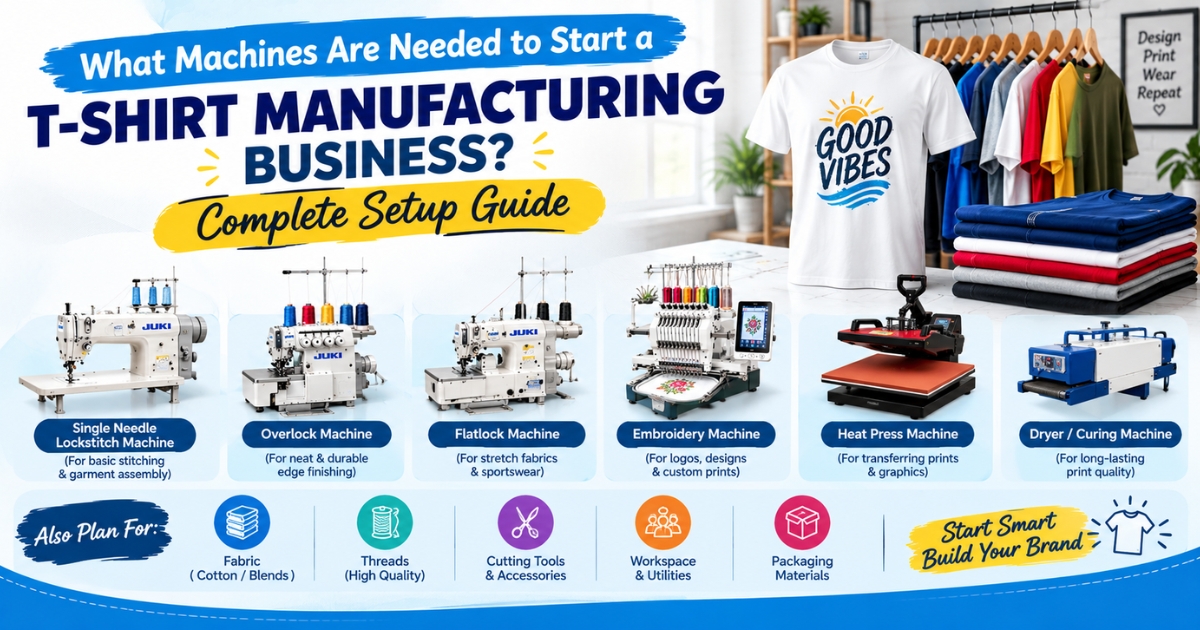
A basic commercial T-shirt manufacturing setup usually needs an overlock machine for joining knit panels, a coverstitch/interlock machine for sleeve and bottom hems, and a lockstitch machine for selected straight-stitch operations. Depending on the T-shirt style and production volume, you may also require cutting equipment, a collar or binding setup, bartack equipment, finishing tools and specialized machines.
The right setup should be decided by the operations required to manufacture your T-shirt, not simply by buying as many machines as possible.

Why T-Shirt Manufacturing Needs More Than One Sewing Machine
A finished T-shirt may look simple, but several different sewing operations are involved in producing it.
The shoulder seam has one requirement. The side seam has another. Sleeve and bottom hems need a different stitch. Neck rib or binding requires another setup.
This is why a single general-purpose sewing machine is rarely the ideal commercial solution.
A better approach is:
T-Shirt Design → Sewing Operation → Required Stitch → Machine Type
This helps a startup invest in machines that actually contribute to production.
1. Overlock Machine - The Core T-Shirt Assembly Machine
For most knit T-shirt production, the overlock machine is one of the most important machines in the unit.
An overlocker can sew the fabric layers while simultaneously controlling and trimming the raw edges.
Typical T-shirt operations include:
- Shoulder joining
- Side seam joining
- Sleeve joining
- Sleeve setting
- Knit garment assembly
- Edge control during construction
For many T-shirt applications, a 4-thread overlock configuration is commonly associated with knit garment assembly because it provides a suitable seam for joining stretch fabrics.
However, machine configuration should always be chosen according to the exact fabric and required seam.
Why not use only a lockstitch?
A conventional straight lockstitch seam does not provide the same stretch behaviour as commonly used knit-sewing systems. When the fabric stretches significantly, inappropriate stitch selection can cause seam stress or thread breakage.
2. Coverstitch / Interlock Machine - For Professional T-Shirt Hems
Look at the bottom of a commercially manufactured T-shirt.
You will normally see parallel rows of stitching on the outside and a covering formation underneath.
This is typically produced using a coverstitch machine, commonly referred to as an interlock machine in many Indian sewing-machine markets.
It is widely used for:
- T-shirt bottom hemming
- Sleeve hemming
- Knitwear finishing
- Neck applications
- Binding
- Elastic-related operations, depending on configuration
This machine is particularly important when you want the finished product to look like commercially manufactured knitwear rather than a basic home-sewn garment.
3. Lockstitch Machine - The General-Purpose Supporting Machine
A single-needle industrial lockstitch is one of the most versatile machines in garment production.
In a T-shirt unit it may be used for selected operations such as:
- Labels
- Certain topstitching
- Reinforcement work
- Attachments
- Sample development
- Non-stretch components
It should not automatically replace the overlock or coverstitch machines.
Think of the lockstitch as a versatile supporting machine, while knit-specific construction operations are assigned to machines designed for those stitches.
4. Collar, Neck Rib and Binding Setup
The neckline is one of the areas where T-shirt quality becomes immediately visible.
Depending on the design, production may require:
- Rib neck attachment
- Neck binding
- Tape attachment
- Top covering
- Specialized folders or guides
A coverstitch machine with the appropriate attachment may perform some binding and collar-related operations.
For larger production units, specialized configurations can improve consistency and operator speed.
Before buying a machine specifically for neckline production, show the supplier the actual neckline finish you want.
5. Cutting Equipment
Sewing capacity becomes useless if cutting cannot supply pieces consistently.
A small T-shirt startup may begin with simple cutting equipment, while larger production can require dedicated fabric-cutting machinery.
Your cutting section may include:
- Cutting table
- Fabric laying area
- Fabric scissors
- Rotary or straight-knife cutting equipment where suitable
- Pattern or marker system
Accurate cutting helps maintain size consistency and reduces rework later in sewing.
6. Bartack Machine - When Reinforcement Is Required
A bartack machine produces concentrated reinforcement stitches at areas exposed to repeated stress.
A basic crew-neck T-shirt may not require extensive bartacking, but it becomes useful when producing garments with:
- Reinforced openings
- Loops
- Pocket stress points
- Specialized sportswear details
- Certain workwear designs
Do not purchase one simply because every garment factory has one. Buy it when your product operations justify it.

Basic T-Shirt Manufacturing Machine Setup
Operation | Typical Machine |
Shoulder joining | Overlock |
Side seam | Overlock |
Sleeve joining | Overlock |
Sleeve setting | Overlock |
Bottom hem | Coverstitch / Interlock |
Sleeve hem | Coverstitch / Interlock |
Selected straight stitching | Lockstitch |
Labels and supporting operations | Lockstitch |
Neck binding | Coverstitch with appropriate setup |
Reinforcement where required | Bartack |
What About Flatlock Machines?
Flatlock and flatseaming machines are useful for specialized low-profile seams found particularly in products such as:
- Activewear
- Sportswear
- Compression garments
- Performance garments
- Next-to-skin products
A normal basic T-shirt manufacturing startup should not automatically buy a flatlock machine.
First determine whether the product design genuinely requires a true flat seam.
Small Startup vs Production Unit
Small Startup
A practical first setup may prioritize:
- Overlock
- Coverstitch/interlock
- Industrial lockstitch
This gives the business the ability to perform the core operations required for many standard T-shirts.
Growing Unit
As volume increases, additional machines may be added to remove specific bottlenecks.
Examples include:
- Additional overlock machines
- Additional coverstitch machines
- Dedicated binding configurations
- Bartack machines
- Specialized cutting equipment
The question is not simply, “How many machines do I need?”
Ask:
Which operation is slowing down production?
Common T-Shirt Manufacturing Setup Mistakes
Buying Only Lockstitch Machines
A lockstitch machine is useful, but it is not a substitute for every knitwear sewing operation.
Confusing Overlock and Coverstitch
An overlocker is primarily used to join and control fabric edges.
A coverstitch machine performs operations such as T-shirt hems and covering.
They solve different production problems.
Buying Based Only on Maximum Speed
Actual production depends on:
- Operator skill
- Feeding
- Handling
- Machine setup
- Cutting accuracy
- Line balance
- Quality checks
- Downtime
The highest stitches-per-minute figure does not automatically create the highest daily output.
Ignoring Fabric Testing
Cotton jersey, cotton-Lycra, polyester sports fabric and other knits can behave very differently.
Always test the machine using the actual fabric you plan to manufacture.
How to Choose Your Setup
Before purchasing, prepare these details:
- T-shirt type
- Fabric composition
- Fabric weight
- Neck style
- Sleeve type
- Required seams
- Expected pieces per day
- Current operators
- Future order volume
- Available workspace
- Approximate budget
A machine dealer can make a much more accurate recommendation from this information than from the statement, “I want to start a T-shirt unit.”
Choosing Your T-Shirt Production Machines with Murthy Sewing Machines
Murthy Sewing Machines can help you shortlist industrial machines based on the actual operations required in your T-shirt production line.
Instead of buying several machines first and deciding how to use them later, plan the garment operation sequence and invest in the equipment needed to complete it efficiently.
Current specifications, machine configurations, accessories, pricing, availability, warranty and service conditions should always be confirmed for the exact model before purchase.
Conclusion
For most commercial T-shirt production, the three foundational machine classes are overlock, coverstitch/interlock and industrial lockstitch.
From there, expand according to your garment style and production bottlenecks.
The most successful setup is not necessarily the one with the most machines. It is the setup where every important garment operation has the correct machine behind it.
FAQs
Can I start T-shirt manufacturing with one sewing machine?
You can create samples with limited equipment, but commercial production normally becomes more practical with dedicated machines for joining and hemming. Overlock and coverstitch machines perform important knitwear operations that a standard straight-stitch machine does not replace well.
Which machine is most important for T-shirt production?
The overlock machine is particularly important for assembling knit garment panels. However, a complete professional T-shirt normally also requires proper hemming, making a coverstitch/interlock machine important.
Do I need an interlock machine for T-shirts?
For commercial-style sleeve and bottom hems, a coverstitch/interlock machine is highly useful. The exact configuration depends on the finish required.
Is a 4-thread overlock suitable for T-shirts?
Four-thread overlock configurations are commonly used for knit garment assembly, but suitability should be checked against the fabric, seam specification and production requirement.
Do I need a flatlock machine?
Not necessarily. Flatlock or flatseaming becomes more relevant when producing specialized sportswear, performance garments or low-profile seams.
Should a startup buy automatic machines immediately?
Not automatically. Automation should solve a real labour, consistency or production bottleneck rather than simply increasing initial investment.
What should I show a dealer before buying?
Carry a sample garment or reference product and explain your fabric, expected production, required seams and budget. This makes machine selection much more accurate.
Can the same setup manufacture polo shirts?
Some equipment can overlap, but polo shirts introduce additional operations such as collars, plackets and buttons. Your production setup therefore needs to be planned separately.