


Flatlock vs Overlock vs Interlock Machine: Which Machine Do You Need for Garment Production?

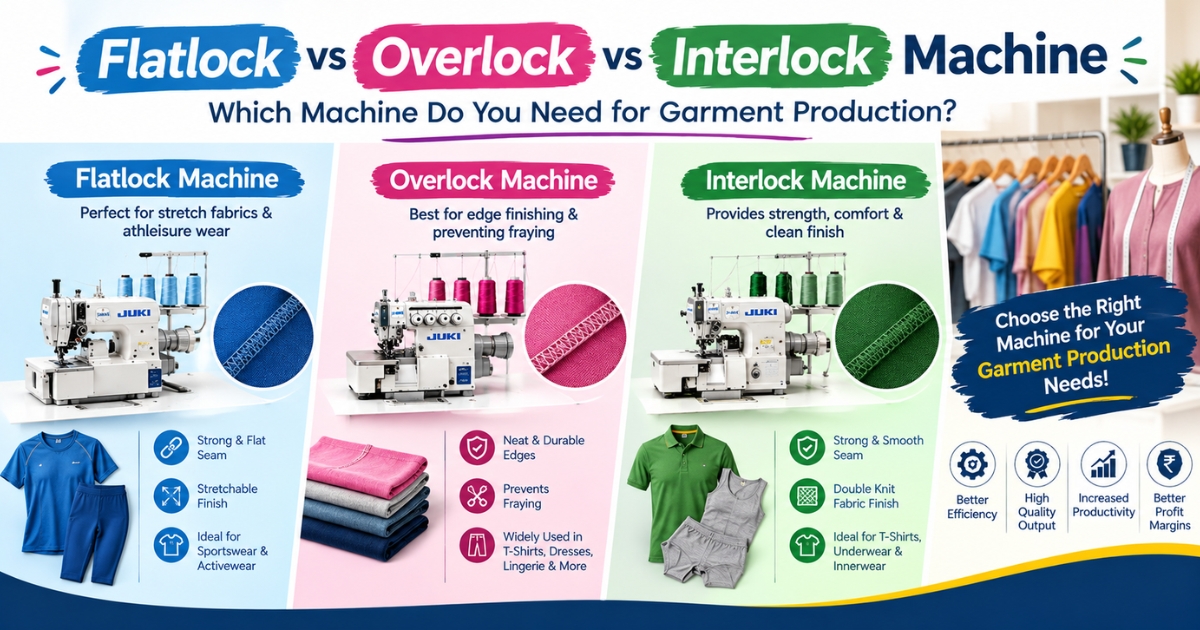
Overlock, interlock and flatlock machines are used for different garment-production operations and should not be treated as interchangeable machines.
Overlock machines are mainly used to join and finish fabric edges while trimming excess material. They are widely used for side seams, shoulder seams and edge finishing in woven and knitted garments.
Interlock machines are commonly used for coverstitch-related operations such as T-shirt bottom hemming, sleeve hemming, covering seams, attaching elastic or binding and other knitwear finishing operations, depending on the machine configuration.
True flatlock or flatseaming machines create very flat seam constructions designed to reduce bulk and improve comfort. They are particularly relevant for activewear, sportswear, underwear and other garments where raised seams can rub against the skin.
For a normal garment production unit, the question is therefore usually not:
“Which one machine is better?”
It is:
“Which garment operations do I need to perform?”
Many professional knitwear production lines use more than one of these machine types.
Why Are Overlock, Interlock and Flatlock Machines So Confusing?
These three terms are frequently mixed together.
You may hear:
- Overlock machine
- Interlock machine
- Flatlock machine
- Flatseamer
- Coverstitch machine
- Flatlock/interlock machine
used differently by dealers, operators and manufacturers.
Part of the confusion comes from regional terminology.
In many Indian tailoring and garment environments, machines used for T-shirt hemming are commonly referred to as interlock machines.
Industrial manufacturers, however, may describe these machines more specifically as:
- Interlock stitch machines
- Coverstitch machines
- Flatbed interlock machines
- Cylinder-bed interlock machines
A true industrial flatseaming machine is another specialised configuration used to create very flat garment seams.
The important thing is not merely what the machine is called.
Before purchasing, identify the exact stitch and garment operation you need.

Overlock vs Interlock vs Flatlock at a Glance
Feature | Overlock | Interlock / Coverstitch | Flatlock / Flatseaming |
Main purpose | Joining and finishing raw edges | Hemming, covering and knitwear finishing | Creating flat low-profile seams |
Cuts fabric edge | Usually yes | Generally no for normal hemming configurations | Depends on machine/configuration |
Typical seam profile | Raised seam allowance inside | Flat coverstitch finish | Very flat seam construction |
Common T-shirt use | Joining garment panels | Bottom and sleeve hemming | Specialised flat seams |
Knitwear | Very common | Very common | Common in specialised garments |
Woven garments | Common | Certain specialised operations | Less common |
Activewear | Used | Used | Particularly useful |
Underwear | Used | Used | Particularly useful for comfort seams |
Edge finishing | Major application | Not primary purpose | Not primary purpose |
Bottom hemming | Not main application | Major application | Different application |
Typical production role | Assembly + edge finishing | Finishing | Specialised seam construction |
The exact capabilities still depend on the particular machine subclass.
What Is an Overlock Sewing Machine?
An industrial overlock machine forms stitches around the edge of the fabric.
In many configurations, a cutting mechanism trims the fabric edge immediately before the stitch is formed.
This means the machine can perform two important operations in one pass:
Trim the edge
and
Sew or finish the edge
This is why overlock machines are fundamental equipment in garment manufacturing.
What Does an Overlock Stitch Look Like?
Look inside a professionally manufactured T-shirt.
Along many internal seams you will see thread wrapping around the joined fabric edges.
That is typically an overlock-type seam.
Instead of leaving raw edges exposed, the thread encloses the edge.
This helps create:
- Cleaner garment interiors
- Controlled fabric edges
- Stretchable seams for suitable knit applications
- Efficient production
What Is an Overlock Machine Used For?
Common applications include:
- T-shirt side seams
- T-shirt shoulder seams
- Knitwear assembly
- Dress seams
- Shirt seam finishing
- Trouser edge finishing
- Children's garments
- Uniforms
- Leggings
- Casualwear
- Garment edge finishing
The exact operation depends on the thread and needle configuration.
3-Thread vs 4-Thread vs 5-Thread Overlock
Not every overlock machine performs the same operation.
3-Thread Overlock
Often used where the main requirement is:
- Edge finishing
- Preventing raw-edge fraying
- Lighter finishing work
It is widely useful in tailoring and garment finishing.
4-Thread Overlock
A common configuration for knit garment assembly.
The additional needle thread can provide a stronger seam construction than a basic 3-thread edge finish.
It is frequently associated with:
- T-shirts
- Knit garments
- Stretch garments
- Casualwear
5-Thread Safety Stitch Overlock
A 5-thread safety-stitch configuration combines overedge finishing with an additional chainstitch-type seam.
This makes it useful where stronger garment construction is required.
Applications can include suitable:
- Woven garments
- Trousers
- Shirts
- Uniforms
- Industrial garment production
Always match the configuration to the garment operation rather than assuming a higher thread count is universally better.
What Is an Interlock Sewing Machine?
In industrial garment terminology, an interlock machine commonly refers to equipment capable of producing coverstitch-related operations using multiple needles and loopers.
These machines are especially important in knit garment manufacturing.
A very familiar example is the bottom of a T-shirt.
Look at a commercially manufactured T-shirt hem.
On the outside you may see:
two or more parallel rows of straight stitching
while underneath there is a looper-based stitch covering the folded edge.
That is a typical coverstitch/interlock application.
What Is an Interlock Machine Used For?
Depending on machine configuration, industrial interlock machines may be used for:
- T-shirt bottom hemming
- Sleeve hemming
- Covering seams
- Attaching elastic
- Attaching binding
- Decorative stitching
- Knitwear finishing
- Underwear production
- Sportswear production
- Children's garments
Industrial manufacturers offer different subclasses specifically for individual operations.
Therefore, simply asking for an “interlock machine” is not enough when setting up a production line.
You should specify the intended operation.
T-Shirt Bottom Hem: The Easiest Way to Understand Interlock
Take a standard T-shirt.
The bottom edge is folded upward.
The interlock/coverstitch machine stitches through the folded fabric.
From the outside, the garment receives clean parallel stitch lines.
From the inside, the looper thread covers the edge.
This produces the familiar professional T-shirt hem.
The same principle is commonly used around:
- Sleeve openings
- Bottom hems
- Certain knit garment edges
This is one of the clearest reasons a T-shirt production unit normally cannot rely only on an overlock machine.
What Is a Flatlock Machine?
The term flatlock needs more careful explanation.
A true industrial flatseaming or flatlock construction is designed to join or connect material while keeping the resulting seam very flat.
Instead of creating a conventional raised seam allowance, the construction reduces seam bulk.
This is particularly valuable where garments sit closely against the body.
Common applications include:
- Activewear
- Sportswear
- Compression garments
- Leggings
- Base layers
- Underwear
- Swimwear
- Certain children's garments
Why Is a Flat Seam Important?
Imagine wearing compression clothing while:
- Running
- Cycling
- Training
- Exercising
A thick internal seam repeatedly rubbing against the skin can become uncomfortable.
A flatter seam reduces the raised seam profile.
This is one reason true flatseam construction is valuable for next-to-skin performance garments.
Flatlock Is Not Simply Another Name for Overlock
This distinction is important.
An overlock seam generally joins fabric while leaving a seam allowance inside the garment.
The resulting seam has some thickness.
A true flatlock/flatseam construction is designed specifically to create a much flatter join.
So although both can be used with stretch garments, their purposes are different.
Is Interlock the Same as Flatlock?
Not always.
This is one of the biggest terminology issues online.
Some sellers and operators casually call coverstitch/interlock machines “flatlock machines.”
You may therefore encounter:
Interlock / Flatlock
used as a combined product label.
But technically, a standard coverstitch hemming operation and a true flatseam construction are not necessarily the same thing.
Industrial manufacturers distinguish between:
- Coverstitch
- Hemming
- Covering
- Flatseaming
even though some machines or machine families may support related stitch classes.
For a buyer, the safe approach is simple:
Never buy based only on the name “flatlock.”
Ask to see the exact stitch and operation.
Flatlock vs Coverstitch: Another Important Difference
These two terms are also frequently confused.
Coverstitch
Commonly produces:
- Parallel needle lines on the face
- Looper coverage underneath
Typical application:
T-shirt bottom hem
Flatlock / Flatseaming
Designed to produce:
a flat seam joining garment sections
Typical application:
activewear panel seam
Both can create a flat-looking finish, but the construction and purpose can differ.
The Simplest Way to Remember All Three
Overlock
Join + Trim + Finish
Interlock / Coverstitch
Hem + Cover + Finish Knit Garment Edges
Flatlock / Flatseam
Join With a Low-Profile Flat Seam
This is a more useful buying framework than simply comparing machine names.
How These Machines Work Together in T-Shirt Production
A good example is a basic knitted T-shirt.
A production workflow may involve several specialised machines.
Operation 1 - Shoulder Joining
An overlock or other suitable assembly machine may be used depending on garment specifications.
Operation 2 - Sleeve Attachment
Overlock is commonly used.
Operation 3 - Side Seam
Overlock is commonly used.
Operation 4 - Neck Operation
The required machine depends on the neck construction and production method.
Operation 5 - Sleeve Hem
Interlock/coverstitch equipment may be used.
Operation 6 - Bottom Hem
Interlock/coverstitch equipment is commonly used.
This immediately shows why:
Overlock and interlock are complementary machines rather than direct substitutes.

Which Machines Are Needed for T-Shirt Manufacturing?
For a commercial T-shirt setup, important machine categories can include:
- Lockstitch machine
- Overlock machine
- Interlock/coverstitch machine
Additional specialised equipment may be required depending on:
- Product design
- Neck construction
- Production scale
- Quality requirements
- Attachments
- Decoration
If you produce specialised activewear, a true flatseaming machine may also become relevant.
Flatlock vs Overlock for Activewear
This comparison becomes particularly important with:
- Gym wear
- Running wear
- Cycling garments
- Compression clothing
- Yoga wear
- Rash guards
- Base layers
Overlock Advantages
Overlock provides:
- Efficient seam joining
- Stretch compatibility when appropriately configured
- Fast production
- Common industrial availability
Its limitation for certain applications is the internal seam allowance.
That creates a raised seam profile.
Flatlock Advantages
A true flatlock seam can reduce the seam ridge.
This can improve comfort in:
- Underarm seams
- Inner-leg seams
- Compression garments
- Other areas with repeated skin contact
That is why performance garments may combine multiple seam constructions instead of using flatlock everywhere.
Should Every Activewear Seam Be Flatlocked?
Not necessarily.
Different parts of a garment experience different mechanical requirements.
A seam may need:
- High strength
- High stretch
- Low bulk
- Low cost
- Fast production
- Decorative appearance
No single seam construction is automatically ideal for every location.
A good garment-production plan selects the stitch based on the specific seam position and function.
Overlock vs Interlock for Knitwear
Knit garments often require both.
Overlock Handles
- Panel joining
- Edge control
- Internal seam construction
Interlock Handles
- Bottom hemming
- Sleeve hemming
- Covering
- Elastic attachment
- Certain binding applications
Trying to replace one with the other can compromise production quality.

Which Machine Is Used for Leggings?
Leggings are an excellent example of why the answer depends on garment construction.
A manufacturer may use combinations of:
- Overlock
- Interlock/coverstitch
- Flatseaming
depending on:
- Fabric stretch
- Seam design
- Waistband
- Hem
- Comfort requirement
- Product positioning
Premium performance leggings may use flatter seam constructions in high-contact zones.
Simpler garments may use overlocked assembly combined with appropriate hemming operations.
Which Machine Is Used for Sportswear?
Sportswear is not one single garment category.
It includes:
- Jerseys
- Shorts
- Tracksuits
- Running tops
- Compression wear
- Gym wear
A loose sports jersey may have very different seam requirements from a compression top.
Therefore:
Overlock: often important for efficient garment assembly.
Interlock: useful for hemming and knit finishing.
Flatlock: useful where low-profile stretch seams are part of the garment design.
Which Machine Is Used for Underwear?
Underwear production places high importance on:
- Stretch
- Softness
- Seam comfort
- Elastic attachment
Depending on the product, manufacturers may use:
- Overlock machines
- Interlock machines
- Flatseaming equipment
- Elastic attaching configurations
Again, there is rarely one universal machine.
Which Machine Is Better for Tailoring Shops?
For a normal tailoring shop handling:
- Blouses
- Churidars
- Salwar suits
- Dresses
- Shirts
- Trousers
- Alterations
an overlock machine is normally much more broadly useful than a specialised flatseamer.
Why?
Because edge finishing is required across many everyday garments.
An interlock machine becomes more relevant if the tailoring business expands into:
- T-shirts
- Knitwear
- Sportswear
- Ready-made garment production
A dedicated industrial flatseaming machine is normally a more specialised investment.
Which Machine Should a Boutique Buy?
It depends on the boutique's products.
Boutique Mainly Producing Woven Garments
Prioritise:
- Lockstitch
- Overlock
along with other machines required by specific designs.
Boutique Producing T-Shirts or Knitwear
Consider:
- Overlock
- Interlock
Boutique Producing Activewear
You may eventually require:
- Overlock
- Interlock
- Specialised flatseam equipment
The business model should determine the machine investment.
Which Machine Is More Important for a Garment Factory?
A garment factory generally should not think in terms of:
“Which machine is best?”
Instead it should map the production sequence.
For every garment, identify:
- Which seam joins panels?
- Which machine finishes edges?
- Which operation hems the sleeve?
- Which operation hems the bottom?
- Is elastic attached?
- Is binding required?
- Are flat comfort seams required?
- Are specialised operations required?
Then assign machines to the operations.
This is known as planning the sewing sequence or operation breakdown.

Garment Type Recommendation Table
Garment | Overlock | Interlock | Flatlock |
Basic T-shirt | Essential/common | Essential/common | Usually optional |
Polo shirt | Essential/common | Common | Usually optional |
Leggings | Common | Common | Useful depending on design |
Activewear | Common | Common | Frequently useful |
Compression wear | Common | Common | Highly relevant |
Underwear | Common | Common | Relevant for comfort seams |
School uniform shirt | Common | Limited/specific | Usually unnecessary |
Formal shirt | Common/finishing | Limited | Usually unnecessary |
Blouse | Common | Limited | Usually unnecessary |
Sports jersey | Common | Common | Depends on design |
Knit dress | Common | Common | Optional |
Babywear | Common | Common | Useful depending on comfort requirement |
This is a general production guide. Actual machine requirements depend on garment design and stitch specification.
Which Machine Works with Stretch Fabric?
All three machine categories can appear in stretch-garment production, but for different reasons.
Overlock
Provides stretch-friendly garment assembly when correctly configured.
Interlock
Provides stretchable hemming and coverstitch operations.
Flatlock
Provides low-profile stretch seams for specialised applications.
The fabric itself also matters.
A lightweight jersey behaves differently from:
- Rib knit
- Lycra blends
- Interlock knit fabric
- Heavy sportswear knit
Machine setup must be adjusted accordingly.
Differential Feed: Important for Knit Fabrics
One useful feature on many industrial overlock and interlock machines is differential feed.
Stretch fabrics can:
- Wave
- Stretch
- Gather
as they pass through the machine.
Differential feed allows the feeding action to be adjusted to help control how the material moves.
This can be especially important for:
- Jersey
- Knitwear
- Stretch fabric
- Lightweight materials
It should still be adjusted according to the material and stitch requirement.
Flatbed vs Cylinder-Bed Interlock Machines
Not all interlock machines have the same machine bed.
Two common configurations are:
Flatbed
Provides a flat work surface.
Useful for many flat garment operations.
Cylinder Bed
Has a narrower cylindrical working area.
This can make certain tubular garment operations easier.
Examples can include:
- Sleeve hems
- T-shirt hems
- Tubular knit garments
The exact machine should be selected according to the operation.

Don't Buy an Interlock Machine Without Checking the Subclass
This is particularly important.
Industrial interlock machine families often contain several subclasses.
One may be configured for:
- Plain seaming
Another for:
- Hemming
Another for:
- Elastic attachment
Another for:
- Binding
Another for:
- Covering an overlock seam
They may look very similar.
Their gauges, folders, feed systems and attachments can differ.
Always identify the actual operation before ordering.
The Same Rule Applies to Overlock Machines
Do not simply say:
“I need an overlock.”
Determine:
- 3 thread?
- 4 thread?
- 5 thread?
- Edge finishing?
- Knit garment joining?
- Safety stitch?
- Lightweight fabric?
- Heavy fabric?
- Top-feed requirement?
Commercial production requires a more precise machine specification than general tailoring.
Does an Overlock Machine Replace a Lockstitch Machine?
No.
An overlock machine is not a universal replacement for a single-needle lockstitch machine.
Lockstitch machines are still widely used for:
- General seams
- Topstitching
- Attaching components
- Construction operations
depending on the garment.
Professional garment production normally uses multiple specialised machine types.
Does an Interlock Machine Replace an Overlock Machine?
Usually no.
Their primary production roles are different.
A T-shirt bottom hem created with a coverstitch/interlock machine does not eliminate the need for an overlock machine to assemble other garment seams.
This is why many T-shirt units require both.
Can an Overlock Machine Make a Flatlock-Looking Stitch?
Certain overlock machines can be adjusted to create a flatlock-style or mock-flatlock effect.
But that should not automatically be confused with the seam produced by a dedicated industrial flatseaming machine.
The construction, strength, appearance and intended production application can differ.
For commercial manufacturing, define the required stitch specification, not merely the visual effect.
Common Buying Mistakes
Mistake 1: Treating Overlock and Interlock as the Same Machine
They usually perform different production operations.
Mistake 2: Calling Every Coverstitch Machine a Flatlock Machine
Terminology varies. Verify the actual stitch.
Mistake 3: Buying Based Only on Thread Count
3-thread, 4-thread and 5-thread configurations serve different purposes.
Mistake 4: Assuming More Threads Means a Better Machine
The correct configuration depends on the operation.
Mistake 5: Ignoring Fabric Type
Woven shirts and Lycra activewear have very different requirements.
Mistake 6: Buying an Interlock Without Checking the Subclass
The machine may be configured for a different operation than you need.
Mistake 7: Focusing Only on Machine Speed
Good production depends on:
- Operator skill
- Feeding
- Attachment setup
- Fabric handling
- Seam quality
- Maintenance
Mistake 8: Buying a Flatseamer When You Only Need T-Shirt Hemming
A standard interlock/coverstitch setup may be the relevant machine for the required operation.
Mistake 9: Trying to Run an Entire Garment Unit with One Machine Type
Garment manufacturing is operation-based.
Mistake 10: Not Testing Your Actual Fabric
Always evaluate the planned fabric and stitch.
Which Machine Should You Buy First?
This depends on your business.
General Tailoring Shop
Usually prioritise:
Overlock
because edge finishing is needed across many garments.
T-Shirt Manufacturing Unit
Usually evaluate:
Overlock + Interlock
alongside the basic assembly machines required by your process.
Knitwear Production Unit
Commonly requires:
Overlock + Interlock
with specialised machines according to products.
Activewear Unit
May require:
Overlock + Interlock + Flatseaming
depending on seam specifications.
High-End Sportswear Production
Dedicated flatseam capability becomes considerably more relevant.
Small Garment Unit Example
Suppose you want to produce:
Basic cotton T-shirts
Your workflow may require:
Single-Needle / Other Assembly Machine
For certain construction operations.
Overlock
For joining appropriate garment sections.
Interlock / Coverstitch
For sleeve and bottom hemming.
You may not initially need a true flatseaming machine.
Now suppose you move into:
Compression gym wear
A dedicated flat seam may become much more valuable because seam profile and wearer comfort become important product features.
Think in Garment Operations, Not Machine Names
This is the most important lesson in this entire guide.
Do not prepare a shopping list such as:
- 10 sewing machines
- 2 overlocks
- 2 interlocks
- 1 flatlock
without first analysing the product.
Instead:
Step 1
Choose the garment.
Step 2
Break it into sewing operations.
Step 3
Specify the required stitch/seam.
Step 4
Choose the machine subclass for each operation.
Step 5
Estimate production volume.
Step 6
Determine how many machines are required.
That is how commercial production planning should work.
Machine Selection by Operation
Production Requirement | Machine to Evaluate |
Raw-edge finishing | Overlock |
Join knit panels | Overlock / appropriate seam machine |
Strong safety seam | Suitable 5-thread safety-stitch overlock |
T-shirt bottom hem | Interlock / coverstitch |
Sleeve hem | Interlock / coverstitch |
Cover an existing seam | Suitable interlock configuration |
Attach elastic | Suitable interlock configuration |
Apply binding | Suitable interlock configuration |
Low-profile activewear seam | Flatseaming machine |
Normal woven construction | Lockstitch and other required machines |
Overlock vs Interlock vs Flatlock: Which Is Most Versatile?
For general tailoring, overlock probably has the broadest everyday usefulness.
For knitwear finishing, interlock becomes essential.
For specialised performance garments, flatseaming adds an important capability.
That does not make one objectively more versatile than another across all garment manufacturing.
They solve different problems.
Which Machine Gives the Most Professional Finish?
This question cannot be answered without specifying the garment.
A professionally produced T-shirt needs the correct combination of seams.
A perfectly flat activewear seam would not make sense merely because it is technically more specialised.
Professional garment quality comes from using:
the correct stitch in the correct location.
Which Machine Is the Better Investment?
The machine that performs a profitable operation your business actually needs.
For example:
Tailoring Shop
An overlock could be used every day.
A specialist flatseamer might remain idle.
T-Shirt Factory
Both overlock and interlock may be heavily utilised.
Activewear Manufacturer
A flatseaming machine may help produce a product finish that the business cannot otherwise offer.
Machine ROI depends on utilisation—not how advanced the machine sounds.
How to Plan the Number of Machines for Production
Once you know the required machine types, calculate how much work each operation receives.
Suppose one overlock operation takes much longer than a hemming operation.
The production line may need:
more overlock machines than interlock machines.
Another garment may create the opposite balance.
Professional production lines use operation timing and line balancing rather than simply buying equal numbers of each machine.
Should a Startup Buy All Three Machines?
Usually not automatically.
If you are starting a small garment unit, buy according to the first products you genuinely intend to manufacture.
For example:
Basic T-Shirt Startup
Overlock and interlock capabilities will likely matter much earlier than specialist flatseaming.
Activewear Startup
Flatseam capability may become important much earlier.
Tailoring/Boutique Startup
Overlock may be sufficient initially alongside your main sewing equipment.
Add specialised equipment as customer demand develops.
Expert Recommendation
If you are confused between flatlock, overlock and interlock machines, stop comparing machines for a moment.
Take one actual garment you intend to manufacture.
Then mark:
- Panel joining seams
- Raw edges
- Bottom hem
- Sleeve hem
- Elastic
- Binding
- Areas touching the skin
- Decorative seams
Now assign the operation.
If the requirement is:
Join and finish an edge
Think overlock.
Create a professional knit hem or coverstitch
Think interlock / coverstitch.
Create a specialised very flat joining seam
Think flatlock / flatseaming.
This process is much more reliable than purchasing equipment based on machine names alone.
Choosing Garment Production Machines with Murthy Sewing Machines
Murthy Sewing Machines helps tailoring businesses, garment units and entrepreneurs evaluate industrial sewing machines according to the actual products they plan to manufacture.
Before enquiring about overlock, interlock or flatlock equipment, prepare:
- Garment type
- Fabric type
- Required seams
- Expected pieces per day
- Current machines
- Production bottlenecks
- Whether work involves woven or knitted fabrics
- Whether stretch garments are involved
- Approximate investment range
Where possible, bring:
- Fabric sample
- Finished garment sample
- Photo of the required seam
This makes it much easier to identify the correct machine class and subclass.
Exact specifications, needle/thread configurations, speed, attachments, motors, warranty, pricing and current stock should always be confirmed for the particular machine before purchase.
Conclusion
Overlock, interlock and flatlock machines are not three competing versions of the same sewing machine.
They perform different jobs.
Remember the distinction:
Overlock → Join, trim and finish edges
Interlock / Coverstitch → Hem, cover and finish knit garments
Flatlock / Flatseaming → Produce specialised low-profile seams
A basic T-shirt production unit may need both overlock and interlock machines.
An activewear manufacturer may require true flatseaming capability as well.
A tailoring shop may use an overlock machine every day while having little need for specialised flatseaming.
So the correct buying question is not:
“Which machine is better?”
It is:
“Which sewing operation does my product require?”
Once you answer that, choosing the correct machine becomes much easier.
Frequently Asked Questions
1. What is the main difference between overlock and interlock sewing machines?
An overlock machine primarily joins and finishes raw fabric edges and commonly trims excess fabric while sewing. An interlock/coverstitch machine is commonly used for operations such as T-shirt hemming, covering seams, elastic attachment and other knitwear-finishing tasks.
2. Is interlock the same as flatlock?
Not necessarily. The terms are often used interchangeably in the market, but industrial machine manufacturers distinguish coverstitch/interlock operations from true flatseaming operations. Always verify the exact stitch and application before buying.
3. Which machine is used for T-shirt bottom hemming?
Industrial interlock or coverstitch machines are commonly used to create the professional parallel-line hem seen at the bottom and sleeves of T-shirts.
4. Which machine is used for joining T-shirt side seams?
Overlock machines are commonly used to assemble suitable knitted garment seams such as T-shirt side seams, depending on the garment specification.
5. Do I need both overlock and interlock machines for T-shirt manufacturing?
For professional commercial T-shirt production, both are commonly required because they perform different operations. Overlock handles important assembly seams, while interlock/coverstitch equipment handles operations such as bottom and sleeve hemming.
6. Is flatlock better than overlock for activewear?
A true flatlock seam can offer a lower-profile seam that is advantageous in high-contact areas of activewear. Overlock remains useful for efficient assembly and other seams. Many garments use different constructions in different locations.
7. Can an overlock machine make a flatlock stitch?
Some overlock machines can create a flatlock-style or mock-flatlock effect depending on configuration. It should not automatically be considered equivalent to a seam created by a dedicated industrial flatseaming machine.
8. Which machine should a tailoring shop buy first: overlock or interlock?
For general tailoring involving woven garments, alterations and regular edge finishing, overlock is usually the more broadly useful first investment. Interlock becomes more relevant when the business handles T-shirts, knitwear and stretch garments.
9. Is a 5-thread overlock always better than a 3-thread machine?
No. They are designed for different seam requirements. A 3-thread configuration can be suitable for edge finishing, while suitable 5-thread safety-stitch machines are used where combined seam construction and edge finishing are required.
10. Where can I buy overlock, interlock and flatlock machines in Chennai?
Murthy Sewing Machines supplies industrial sewing equipment in Chennai and can help businesses identify the appropriate machine based on garment type, fabric, seam operation